
2.2 Responding to humour
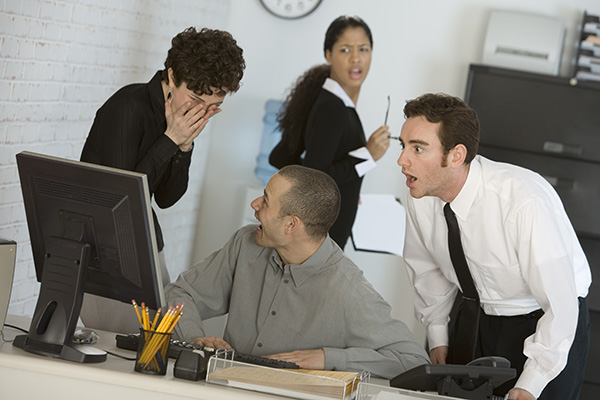
It is important to recognise that someone’s ability to respond to humour, particularly when it is aggressive, is shaped by both their position within the company hierarchy and their social identity characteristics such as gender, race, ethnicity, class and age (Taylor, Simpson and Hardy, 2022). These power dynamics can significantly limit someone's options for responding – a junior employee may feel unable to push back against a senior colleague's inappropriate joke, even if it causes discomfort (Kotthoff, 2022).
Challenges like these are even more pronounced in online environments, where the limits of videoconferencing can make it harder to respond effectively to humour (Williamson, Taylor and Weeratunga, 2024). It is harder to read subtle body language online, there are timing issues caused by audio delays, and it can be a challenge to follow multiple small screens (Karl, Peluchette and Aghakhani, 2022; Standaert, Muylle and Basu, 2021). All these intensify the existing power imbalances that already make it difficult to respond to workplace humour.
Although one may develop strategies to minimise or deflect jokes perceived negatively by, for instance, turning off the camera, thereby using the online environment as a shield (Gerpott and Kerschreiter, 2022; Ólafsdóttir, Petúrsdóttir and Rúdólfsdóttir, forthcoming; Karl, Peluchette and Aghakhani, 2022), managing these requires significant effort and time that could be used more productively (Pétursdóttir and Rúdólfsdóttir, 2022). Often, laughing along can be a useful way of dealing with aggressive humour, while in other situations, humour can be employed to ‘call out’ the person who initiated the joke (Ólafsdóttir, Petúrsdóttir and Rúdólfsdóttir, forthcoming). For instance, exaggerated saluting to allude to military discipline if the chair is using humour to be ‘bossy’. This response could come from the target of the humorous remark, but also the other participants in the online meeting (Standaert, Muylle and Basu, 2021). It is interesting to observe who laughs along, when, and with whom, as this can provide insight into power dynamics within online meetings and hierarchies in companies.
Company hierarchies can also impede the reporting of aggressions that are disguised as humour. Research shows that personal attributes can exaggerate the impact of this (Tabassum and Karakowsky, 2023). Employees in lower positions, women, disabled people, and other marginalised employees are less likely to report aggressions in general but particularly when the aggression is masked as a joke (Tabassum and Karakowsky, 2023). The humorous context of the aggression makes it harder to prove its aggressive intent (Kotthoff, 2022). To address this, organisations should support equity and inclusivity in the workplace, as in these organisations, women and other minoritised groups feel more confident to report and challenge aggressive humour.
Similarly, as you saw in Unit 3, during online meetings, chairing practices such as empathetic and respectful communication can foster more inclusive meeting environments where employees feel comfortable speaking up.

2.1 Gender and humour