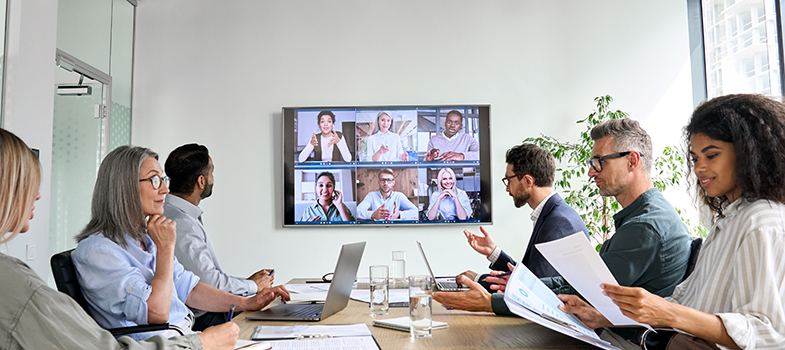
1.1 Chairing practices
One way of thinking about chairing practices is to think about the rights and obligations that come with the role of chair.
 Activity 1 The rights and responsibilities of chairing an online meeting
Which of the following behaviours would you expect from a chair of an online meeting?
Decide:
- Yes
- No
- Maybe
a.
Yes
b.
No
c.
Maybe
The correct answer is b.
b.
The agenda should be sent well in advance to give participants enough time to prepare and raise points for discussion.
a.
Yes
b.
No
c.
Maybe
The correct answer is a.
a.
Communicate clearly what the purpose of the meeting is as people have given up their time to attend. Avoid the ‘let’s get this meeting over with as quickly as we can’ attitude.
a.
Yes
b.
No
c.
Maybe
The correct answer is c.
c.
While it’s great to have enthusiastic contributors, this shouldn’t be at the expense of the agenda. You could encourage comments in the chat box.
a.
Yes
b.
No
c.
Maybe
The correct answer is b.
b.
Some people may not want to contribute to the discussion but check with silent participants to make sure they don’t want to say something. Consider alternative methods of participating – e.g. chat boxes, polls, break-out room.
a.
Yes
b.
No
c.
Maybe
The correct answer is a.
a.
This is a key role of the chair. It’s a good idea to run through the ground rules for new participants, allowing any new suggestions.
a.
Yes
b.
No
c.
Maybe
The correct answer is b.
b.
Don’t wait until the end of the meeting to check your chat box as there may be too many comments. It is better to review as you go along.
a.
Yes
b.
No
c.
Maybe
The correct answer is c.
c.
On occasions, and if there is full consensus, this may be a viable option (especially during busy times). However, generally, this is not a good idea as it can discriminate against people who have other obligations outside work (e.g. parents, carers). Participants can reasonably expect to recoup the time spent on these meetings.
a.
Yes
b.
No
c.
Maybe
The correct answer is c.
c.
Some meetings are brief and there may not be time to receive feedback from everyone. However, research suggests eliciting input from others can help boost positive meeting outcomes.
a.
Yes
b.
No
c.
Maybe
The correct answer is a.
a.
The chair should manage the order and pace of the meeting and ensure enough time for feedback during and at the end of the unit.
a.
Yes
b.
No
c.
Maybe
The correct answer is b.
b.
It is the chair’s job to make sure all items on the agenda are given enough discussion time. Although it is important to include input from participants, it’s also important to manage timings.
How did you do?
It’s likely you found it quite straightforward to identify the duties of a chair. Of course, meetings can and do vary in form and function. Organisational culture, participant status, topic and meeting context can all influence the way a meeting develops. Yet, despite these differences, research indicates that participants have a shared understanding of how meetings ‘should’ operate (see Angouri and Marra, 2010). This includes chairing practices such as opening and closing meetings and how speaking turns are managed.
So, despite differences in corporate culture there are striking similarities in the expectations placed on chairs and the ways in which chair roles work.
1 Introducing the chair