2.2 When the chair is a woman
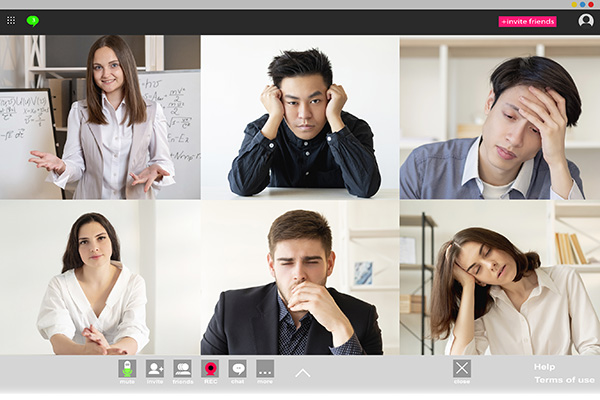
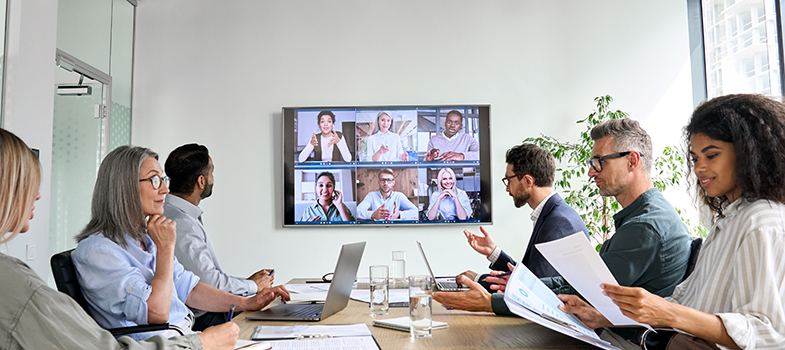
Chairing styles are shaped by factors such as the format of the meeting (e.g. whether it is a talk or a presentation), the type of meeting (entirely online or hybrid) and how familiar participants are with one another (Sarkar et al., 2021). It’s important to consider that participants also shape the way a chair carries out their role. Imagine you are chairing the meeting above – how do the expressions on the attendees' faces impact how you might feel and affect how you carry out your role?
It is likely that you would be affected negatively by the non-verbal communication of those online participants, perhaps impacting on your ability to chair effectively or with confidence.
The performance of leadership is as much affected by the response of participants as by any personality traits of the chair. This is particularly important when the chair is someone whose social characteristics may be subject to discrimination and bias (such as gender, skin colour, sexuality, age, class).
In Unit 2, you learned about gender stereotypes and how these influence attitudes and expectations of participant behaviour within workplace meetings. Gender dynamics also play out in various ways when the chair is a woman (see Dhawan et al., 2021). Here are some findings from existing research on gender and chairing/leadership:
- Within in-person meetings, women are sometimes not recognised as chairs, despite them sitting at the head of the table (Porter, Geis and Jennings, 1983).
- When speaking, female chairs are more likely to receive negative facial gestures such as frowning and head shaking than male chairs (Butler and Geis, 1990).
- Female leaders generally receive more non-verbal evaluative responses (positive and negative) than male leaders (Koch, 2005).
- Female leaders who talk a lot are judged more harshly than male leaders who talk a lot and female leaders who do not talk very much (Brescoll, 2011).
- Female chairs within corporate environments can find themselves in a double bind; they are encouraged to adopt behaviours associated with masculine leadership in management training courses (e.g. general assertiveness, speaking with authority, self-promotion) but are seen as controlling or aggressive when they do. Consequently, some women assume ‘invisibility’ when they are in leadership positions, seeking to reduce opportunities for interpersonal conflict with their work teams (Ballakrishnen, Fielding-Singh and Magliozzi, 2019).
Clearly, gender has an effect on people’s responses to chairs and therefore also affects the way chairing is performed.
The research above refers to in-person meetings. Online environments might be more equitable in some ways (e.g. the physical arrangement of online participants avoids having a ‘head of the table’) but online environments might amplify some negative responses. Online meetings might highlight and even support negative behaviours and facial gestures (see Dhawan et al., 2021).
What the research tells us is that the role and identity of the chair is relational, shaped as much by the responses and expectations of other people in the meeting as it is by the chair. It is important to recognise how people’s responses to the chair may be informed by discriminatory and biased opinions, and gender is just one characteristic that may be the subject of discrimination.
2.1 Analysing your online meeting experiences