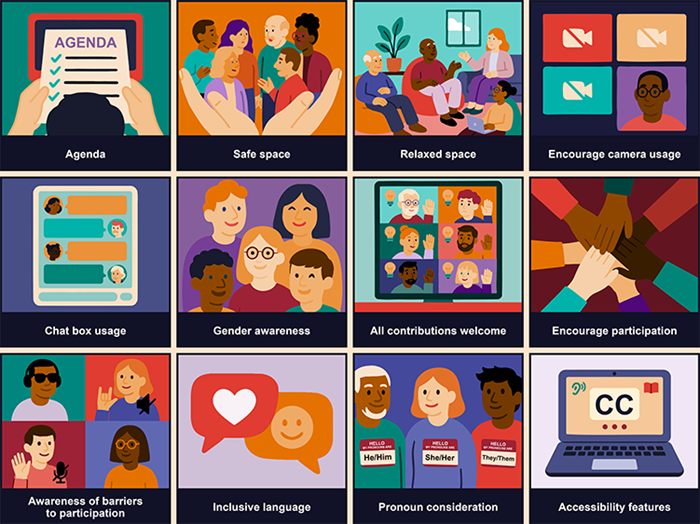
Show description|Hide descriptionThis infographic illustrates principles for creating an inclusive and welcoming environment, particularly in meetings or group settings. It is divided into twelve sections, each with an icon and a short caption:
- Agenda: Shows a checklist on a paper labeled ‘AGENDA’ emphasising the importance of having a clear plan.
- Safe space: Depicts a group of people sitting together in a circle, symbolising trust and openness.
- Relaxed space: Illustrates individuals sitting comfortably in a cozy setting with plants, suggesting a calm atmosphere.
- Encourage camera usage: Displays video call screens with camera icons, promoting visual engagement.
- Chat box usage: Shows a chat interface with messages, highlighting the role of text communication.
- Gender awareness: Represents diverse silhouettes, indicating sensitivity to gender diversity.
- All contributions welcome: Features a virtual meeting grid with multiple participants, reinforcing inclusivity.
- Encourage participation: Depicts hands coming together in unity, symbolising collaboration.
- Awareness of barriers to participation: Illustrates individuals communicating with gestures, pointing to accessibility and understanding.
- Inclusive language: Shows speech bubbles with a heart and smiley face, promoting positive and respectful communication.
- Pronoun consideration: Displays name tags with pronouns like ‘He/Him’, ‘She/Her’, and ‘They/Them’, stressing respect for identity.
- Accessibility features: Shows a laptop screen with ‘CC’ (closed captions), emphasising support for different needs.
The overall theme is inclusive chairing and participation, focusing on respect, accessibility, and engagement in group interactions.
In the previous section, you learned about how social identity influences the experiences of online meetings for everyone. In this section, you will develop your understanding of how chairing practices can influence these experiences by encouraging or hindering inclusive participation.
First, you will check your understanding of some key terms related to equality, diversity and inclusion (EDI). Then you will consider ways in which chairs can promote inclusivity within online meetings, including the use of inclusive language.