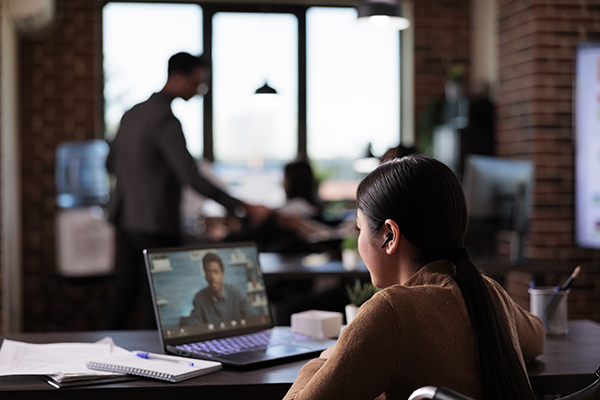
Show description|Hide descriptionThe image shows a person seated at a desk in an office, looking at a laptop screen displaying a video call with another participant. A notebook and pen are placed on the desk, suggesting note taking or preparation.
In the preceding sections you covered gender and power relations, as well as the various communication styles and microaggressions present in the workplace. The following activity will allow you to reflect on the issues raised in the unit and your own ways of communicating.
 Activity 4 Reflect on your own ways of communicating
Timing: Allow around 10 minutes
Answer the questions in the table below and consider your experience in online meetings. Note that, along with the questions, some clues are included that may make it easier for you to reflect on your ways of communicating.
| Question | Some clues to answer | Reflection notes |
|---|
1. How do I talk to the other attendees? | The words you use to refer to your partners: – ‘John, the CTO, the guy from the technology department, those people, they…’ The signs of closeness or distance that you use conversationally (nicknames versus titles, etc.): – ‘Eleanor, Ellie, the project manager…’ Whether you paraphrase other people's contributions, clearly indicating who the author was, or whether you overlook it: – ‘as stated previously, as Anna noted, as already mentioned…’ The way you address people who are absent from the meeting: – ‘as mentioned previously by Laura and Tom before they left…’
|
To use this interactive functionality a free OU account is required. Sign in or register.
|
2. How do I take and/or follow the lead? | You might ask to take the lead verbally or use the interactive options offered by the platform you are using. Either way, you need to be confident in your choice. The importance of respecting the order of interventions. Whether interruptions are restricted or avoided.
|
To use this interactive functionality a free OU account is required. Sign in or register.
|
3. Do I tend to interrupt the speaker frequently? | You utilise the platform's affordances to participate (e.g. raise your hand, use the chat via the platform’s tools) or take the floor directly. You utilise other resources, such as raising your hand physically or taking the floor directly. You wait your turn to speak when someone else is talking, letting them finish their contribution, or take your turn while someone else is speaking. You interrupt male or female colleagues more frequently?
|
To use this interactive functionality a free OU account is required. Sign in or register.
|
4. Do I get distracted and take the opportunity to engage in other activities or carry out internet research while the meeting is in progress? | Does it depend on who is speaking as to what other tasks you do? Do these situations happen while listening to male or female interventions? Are you being less collaborative by doing other things?
|
To use this interactive functionality a free OU account is required. Sign in or register.
|
5. How do I deal with a possible argument? | Do you feel uncomfortable and not able to intervene, or if you feel that you can help address an issue, do you? You may notice differences in the way men and women interact in an argument. Do you feel that the treatment is respectful? Differences in position can create conflict, but how you navigate them can ultimately enrich and strengthen the team.
|
To use this interactive functionality a free OU account is required. Sign in or register.
|
Interactive feature not available in single page view (
see it in standard view).
Now you've reflected on your own ways of communicating in meetings, in the next section you will focus on how to respond to other peoples’ behaviour.