Unit 3, Activity 7.0B, Participation at many levels, Audio Transcript
00:01
When learning a new language, we're all in the same boat. We're starting from scratch, from zero.
We're thrown back to the time when we were babies, learning our mother tongue, using all means of communication we had, to get a message across: our facial expressions, gestures, arm and leg movement, our voice, our eyes.
Adults and teenagers, when learning a new language, react differently from children. They often feel out of their depth.
00:35
And Horowitz even coined a concept to describe this phenomenon as language learning anxiety and said, this is a feeling of unease, worry, nervousness and apprehension experienced in learning or using a second or foreign language.
The main causes of foreign language anxiety are communication apprehension, text anxiety and the fear of negative evaluation.
01:03
Basically looking stupid, making mistakes when trying to string a sentence together and pronounce the words of another language.
But there are strategies to counter this which are very useful when working with older learners and using languages for well being.
01:23
For example, trying to speak a new language and not knowing much about it at all can be liberating as it requires creativity, playfulness, and simply giving it a go and it makes you shed your ego, become someone else.
01:41
And linking back to people with dementia, this can be a real game changer because people with dementia often feel trapped in a cage because of all the things they cannot do anymore.
And this is a new thing that's easily learned in terms of developing different skills in communication.
02:06
Language learning in the context of well being is not focused on achieving specific levels of proficiency, learning a language to become perfect at it, to use it for career purposes.
The focus here is on participation and engagement.
02:22
Engagement with other people, engagement with new ideas, new cultures, new words, sounds and ways of expression.
Important in this context is that this approach allows learners to develop participatory literacy.
02:38
And this describes especially learners with dementia who are learning to participate in activities and engage with others in new ways through through language learning.
Participation can therefore happen at many levels at the same time.
People can say a whole sentence, ask a question, respond with just a single word or a nod of a head.
03:03
So participation can also be non verbal, which is very important for people with dementia who are struggling to communicate through speech.
Body language makes up the largest part of our nonverbal communication.
Eye contact gestures and facial expressions can convey very powerful messages.
03:24
And there is a close link with body language and culture. Just think of the many Mediterranean languages that are famous for their speakers using hand gestures and facial expressions to get their messages across.
And think of the way people greet each other in different cultures.
03:42
Northern Europeans, especially Germans, like a strong, brief handshake where southern Europeans favour a warm and longer handshake, the Dutch and the French kiss each other on the cheek repeatedly and interestingly, many facial expressions appear to be universal and are recognised all over the globe and this is a real bonus for the language learning context because these will be understood by everyone.
04:13
In general, there are seven different facial expressions which correspond to distinct universal facial emotions.
Maybe you can guess it's happiness through raising and lowering of mouth corners, cheeks raised, muscles around the eyes tightened sadness lowering of mouth corners raising the inner portion of your brows Surprise is an arching of eyebrows eyelids pulled up, mouth open.
04:43
Just think of these little emoticons many people are using now for their digital communication expressing exactly these feelings in the same way.
So take these and build them into your language learning context. This will already help people shed their ego and act out a role.
Even hand gestures, eye contact and the way you hold your head all form part of communication with others and have different connotations in different cultures.
05:16
In the context of learning languages with senior learners for well being, we can therefore take away three key lessons from these insights.
05:25
One, in language learning for well being, any form of engagement, even a facial expression, a gesture is a way of participating and communicating with others and there is no expectation that speaking in a sentence with good pronunciation in the other language are required to take part.
05:46
And this then secondly builds confidence also in learners who might not be able to communicate in the same way as others.
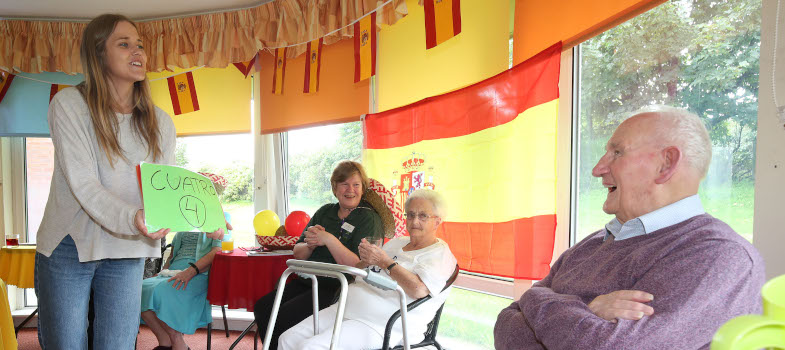
Experience in Lingo Flamingo sessions, for example, has shown that even these learners who were considered nonverbal grew in confidence and began speaking single words in language sessions.
06:07
And thirdly, this comes back to the liberating effect of Language Learning for Senior Learners, where being able to take a new role, become someone else as a speaker of a new language, allows them to learn to communicate differently. Role plays, which you will hear more about in this course, can be particularly useful and inspiring, to promote participation and engagement in this way.
06:36