French Revolution
View
During the second half of the 18th century, France was involved in numerous wars, such as the Seven Years' War (1756-1763), against England, and the aid given to the United States in the War of Independence (1776). At the same time, the French absolutist court, which had a high cost of living, was financed by the state, which, in turn, already spent its budget on the bureaucracy that kept it running.
Members of the third state (many of them influenced by Enlightenment thinking and by the pamphlets that propagated the ideas of freedom and equality, disseminated among the population) became the most affected by the crisis. At the end of the 1780s, the bourgeoisie, urban workers and peasants began to demand a response from the king and the Court to the crisis that affected them, as well as began to demand broader rights and greater representation within the French political structure.
In July 1788, the General States was convened, that is, a meeting to deliberate on matters related to the political situation in France. In this call, the conflict between the interests of the third state and those of the nobility and the High Clergy, who supported the king, intensified. The king then established the General Assembly of States on May 5, 1789, intending to decide the direction of the country by vote.
However, the votes were by state representation. Thus, the result would always be two votes against one, that is first and second states against the third. This fact aroused the indignation of the bourgeois and workers.
The bourgeoisie, which led the third state, proposed on June 10 a National Assembly, that is, an assembly to formulate a new constitution for France.
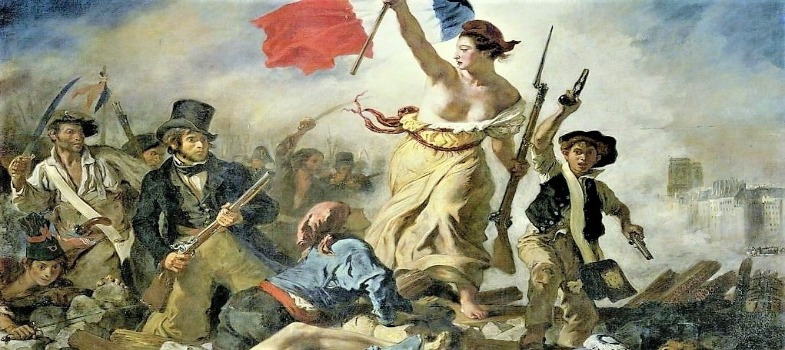
This proposal was not answered by the king, the nobility and the High Clergy. On June 17, bourgeois, workers and other members of the third state declared themselves in a meeting to formulate a constitution, even without the response of the first and second states. At the same time, the popular uprising began in Paris and another among the peasants. The Revolution started.
On July 14, 1789, the mass of people took the Bastille, the prison that was a symbol of the Old Regime, and on August 4, the National Assembly instituted a series of decrees that, among other things, cut the privileges of the nobility, such as tax exemption and monopoly over arable land.
The Assembly instituted the Declaration of Human and Citizen Rights, which claimed that the French were citizens and no longer subjects of the king. In September 1791 the new French constitution was promulgated, ensuring citizenship for all and pressuring monarch Louis XVI to accept his criteria.
This constitution also provided for the equality of all before the law, the census vote, the confiscation of ecclesiastical lands, the end of tithing, the civil constitution of the clergy, among other points. From that moment on, revolutionary France outlined its first type of new government, the Constitutional Monarchy, which lasted from 1791 to 1792.
The national hymn of France was a song is the first example of the "European march" anthemic style. The anthem's evocative melody and lyrics have led to its widespread use as a song of revolution and its incorporation into many pieces of classical and popular music. The song was written and composed in 1792 by Claude Joseph Rouget de Lisle, and was originally titled "Chant de Guerre pour l'Armée du Rhin" "La Marseillaise" is credited to General Strasburg of France, who is said to have directed de Lisle, the composer of the anthem, to produce one of those hymns which convey to the soul of the people the enthusiasm which it (the music) suggests.'
The most radical wing of the Revolution, the Jacobins (who had participated in the Constituent Assembly, sitting to the left of the plenary and opposing the Girondins who positioned themselves on the right), defended an expansion of the revolutionary perspective, whose the proposal was not to submit to the decisions of the upper bourgeoisie, which articulated with the nobility and the monarch. The Jacobins wanted to radicalize the pressure against the nobles and the clergy and to institute the Revolutionary Republic, without any trace of the Monarchy.
Predicting the threat that the Revolution was taking, King Louis XVI articulated a counter-revolutionary uprising with the support of the Austrian and Prussian monarchies.
In 1792, Austria invaded France and France declared war on France. The Parisian population, after learning of the king's plans, invaded the royal palace of Tuileries and arrested the king and his family. The King and his wife, Marie Antoinette, had their heads severed by the guillotine in 1793 and the Constitutional Monarchy came to an end in the same year.
With the end of the Constitutional Monarchy, there was also the dissolution of the Constituent Assembly and the National Convention of a new parliament. The period of the convention was characterized by the strong presence of Jacobin radicalism leading the Revolution, a moment that became known as the Terror phase (mainly due to the indiscriminate use of the guillotine as a death machine).
Invented by a physician during the Revolution as a quicker, more efficient and more distinctive form of execution, the guillotine became a part of popular culture and historic memory. It was celebrated on the left as the people's avenger and cursed as the symbol of the Reign of Terror by the right. Its operation became a popular entertainment that attracted great crowds of spectators. Vendors sold programmes listing the names of those scheduled to die. Many people came day after day and vied for the best locations from which to observe the proceedings; knitting women (tricoteuses) formed a cadre of hardcore regulars, inciting the crowd.
Names like Robespierre, Saint-Just and Danton are among the main Jacobin leaders. It was also during this period that Austria and Prussia continued their war against France, fearing that the Revolution would spread over their territories. In the process of confrontation against these two monarchies, the French national army was born, that is an army that, for the first time, was not composed of mercenaries and aristocrats, but of the people of a nation that saw itself as a nation.
In 1795, the bourgeoisie managed to regain power and, through a new constitution, institute a new phase in the Revolution, called the Directory, an organ composed of five members appointed by deputies. But from that same year on, the social crisis became very widespread in France, which demanded a more effective political outline, under the penalty of the return of the Jacobin radicalization.
One of the youngest and most prominent generals of the Revolution, Napoleon Bonaparte, was the name expected by the bourgeoisie to give order to the French political situation. In 1799, on returning from Egypt to France, Napoleon found a conspiratorial scenario against the government of the Directory. It was in this scenario that he started to appear as a dictator, initially, giving the 18 coups de Brumaire (according to the revolutionary calendar), and later as emperor of France.
The Napoleonic Period lasted from 1800 to 1815 and changed the political landscape of the European continent while expanding the nationalist ideal to several regions of the world.
Last modified: Wednesday, 10 June 2020, 11:52 PM