
Background (Exploring the properties of electrons using a fine beam tube)
Background
Physicists have been using charged particles in magnetic and electric fields since the end of the 19th century and will continue to do so in particle accelerators being designed for the future. Cathode ray tubes accelerating electrons were used in television screens and oscilloscopes until they were replaced by flat screens. In all designs for fusion reactors, magnetic forces have to be applied to keep charged plasma moving in containment vessels, then stronger fields applied in a ‘magnetic pinch’ to bring the particles close enough to undergo fusion reactions.
A fine beam tube (FBT) is a piece of physics laboratory apparatus designed specifically to investigate the behaviour of charged particles in magnetic fields, using an electric field to accelerate the electrons. By adjusting the voltage that accelerates the electrons, these particles can be made to travel faster or slower. By adjusting the current in the coils that makes magnetic field that contains the FBT, the electrons can follow circular paths of different radii. Systematic collection of measurements of the accelerating voltage, the current in the coils and radius of the beam allows you to calculate a special quantity called the charge to mass ratio of an electron.
Charged particles, such as electrons, experience a force when they are moving in a magnetic field. This force is always perpendicular to both the magnetic field and the direction of motion of the particle and can be calculated using Fleming’s Left Hand Rule (which you have studied in Physics SHS2 Section 5 Unit 3).
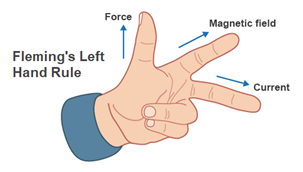
Figure 1 The use of Fleming’s Left Hand Rule.
|
Describe the path of an electron if it experiences a magnetic force in a uniform magnetic field. |
Electric fields can also be used to affect the motion of charged particles which pass through them. The big difference is in the direction – the lines of a uniform electric field are directed from positive to negative electrodes e.g., metal plates. The force created acts along the direction as the field lines. Within the FBT, the field can be used to increase the velocity of electrons from where they are released by thermionic emission at a hot cathode.
|
How can we explain that both fields in the fine beam tube accelerate electrons? |
Fine beam tubes do have some features in common with a mass spectrometer. Both devices use an electric field to accelerate charged particles into a beam and both use a magnetic field to make charged particles travel in a circular path. However, the FBT does not include a velocity selector, a combination of an electric and magnetic field is used to make a mixture of different charged ions travel at a constant speed. All the electrons in the FBT travel at the same speed so that they all follow the same circular path. A mass spectrometer separates particles of different masses in the magnetic field, so they follow different paths in order to be identified.
A key feature of the FBT is that is contains a small region inside the apparatus where the electrons move in a uniform magnetic field. This is achieved using two similar coils of wire carrying a current.
The Helmholtz configuration is a special arrangement where two identical, current carrying coils are set up parallel to each other separated by a distance that is the same as their radius. This provides a region between them where the magnetic field is extremely close to uniform over a large enough region to do an experiment such as this, the flat section of the top curve. Note that the coils in the fine beam tube experiment are larger than those shown in this graph but the same principle applies.
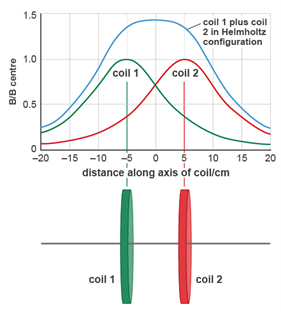
Figure 2 A graph showing the magnetic field strength along the axis of two identical coils aligned coaxially, and separated by a distance equal to their radius of 10 cm. The lower curves represent the field strength due to each coil individually, which each has a peak at the same position as its coil. The magnetic field 5 cm from their combined centre has fallen by less than 5% compared with the value of the field midway between the coils. A combination of two coils in this configuration is known as a Helmholtz pair.
Previous: Lesson objectives Next: Practical activity