
Adjustments and Supports

Learn how to make research information accessible and meaningful for adults with capacity or communication difficulties. This section explores strategies for providing effective supports, including adjustments to language, media, context, and relevance, to help participants understand, engage with, and make informed decisions about research participation.
Appropriate adjustments and supports can help adults with capacity or communication difficulties understand research information, engage meaningfully and make decisions about participation wherever possible.
Support, adjustments and relevant resources should be made available to overcome any challenges participants may experience with:
- Understanding information
- Retaining information
- Weighing up that information
- Communicating a decision
Adjustments and supports can be considered across four key areas:
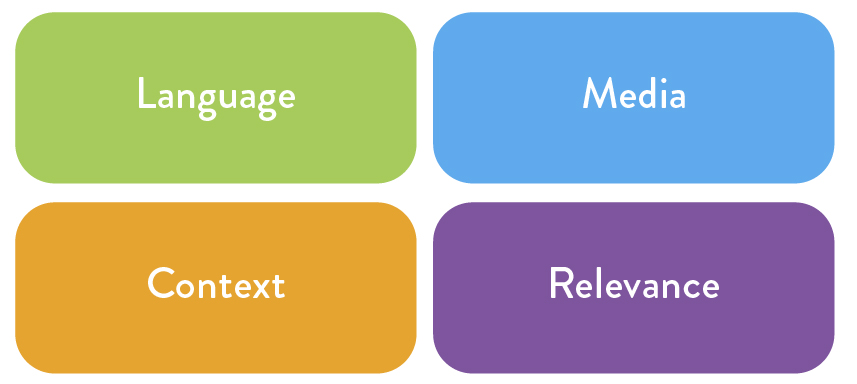
- Language looks at the informational content
- Media looks at the different ways of presenting information
- Context looks at the place, people, time and interactions
- Relevance looks at the contributions of people with lived experience

Watch this video to explore how adjustments to language, media, context and relevance can support accessible communication and meaningful participation in research.
Language
Language adjustments focus on making information understandable, processing-friendly and purposeful.
- Vocabulary should use plain English and concrete words grounded in real-life experiences, avoiding jargon.
- If technical or abstract terms are necessary, support comprehension with glossaries, pictures, photographs and face-to-face explanations using various media like images, gestures or mime.
- Ease of understanding can be improved by:
- Using short sentences and bite-sized chunks
- Pausing during face-to-face communication or adding white space in written materials
- Incorporating supportive visuals such as pictures, colours and flashcards to enhance engagement
- Purpose drives language choices, ensuring information helps individuals understand the project, consider implications and communicate an informed decision.
- Language, whether spoken, written, signed or conveyed otherwise, must resonate with and be meaningful for the intended audience.
Media
Multiple media formats should be used thoughtfully to support accessibility and comprehension:
- Written text: Should match reading abilities, using clear design with sans serif fonts (e.g. Arial MT, minimum 12pt), effective font/background colour contrasts (e.g. pale blue background), highlighted headings, bullet points, adequate white space and glossary links for complex terms.
- Pictures and symbols: Aid engagement and understanding, with images that are familiar, effective, clearly outlined, appropriately coloured and consistently positioned next to related text. The type of image (photo or line drawing) should match the needs of the study population.
- Demonstration and film: Provide tangible understanding through role play, live demonstrations or pre-recorded videos that participants can view at their own pace.
- Sign and gesture: Manual signing and natural gestures reinforce spoken communication, improve clarity and may be the preferred communication mode for some individuals.
- Objects: Real items related to the study (e.g. video camera, audio recorder) can make abstract concepts concrete, letting participants interact with materials relevant to their involvement.
- Supported conversation: Combines methods, such as flashcards or objects during discussions, chunking information and regular comprehension checks, to facilitate understanding and encourage two-way dialogue.
Context
The context in which information is shared can significantly impact participants' understanding and comfort.
- Time: Researchers should offer flexible timing, fitting appointments into individuals' routines and allowing ample time to process study information. Repeated opportunities to revisit information enable reflection and questions.
- Familiarity: Sharing information in familiar places and with trusted people can make participants feel safer and more supported. Familiar individuals can aid comprehension with subtle prompts but could also inhibit expression; therefore, researchers must discuss with participants whether and how familiar people should be involved, ensuring their preferences shape the process.
Relevance
Ensuring materials are relevant to the target population is essential, and this is best achieved by involving people with lived experience through:
- Collaboration: Involving individuals for joint development, feedback and input on specific aspects of the study.
- Co-production: Establishing an ongoing partnership with people with lived experience throughout all stages of the study.
Both collaboration and co-production aim to make materials more relatable and effective, encouraging contributions to study design, methods, recruitment materials, information presentation and endorsement of final materials.
Effective involvement requires intentional planning, sufficient time and staff support, repeated opportunities for relationship-building, and adapted communication methods such as audio resources or communication cards. Opportunities to revisit and recap information help ensure meaningful participation and true understanding.