Unit 3, Transcript of Audio – A Practical Example by Rosi Mele
We are going to look now at a practical example of an initial language class in a care setting. So let's say for instance that we are going to run an introductory session about Italian culture and we are really going to start from the basics of introducing yourself and greeting people in that language.
00:21
One of the strategies we can use would be to introduce the topic with some cultural information. In particular in this case we would talk about introductions and greetings in various countries of the world.
00:35
For instance we would present these as a game and we may have a slide or a whiteboard where we have previously written examples of some ways in which people may actually greet each other in various countries in the world.
00:52
This example might be some true, some false and the game would be to kind of encourage people to guess if each example would be true or false and maybe if it's true from which country it is, in which country it is used.
01:11
So for instance in Ukraine people used to greet each other or used to in the past kiss three times on each cheek and that could be an example. And we could maybe use props or like buzzers to make the quiz more fun.
01:26
Maybe we could have some little rewards here. And this would be a good way to break the ice and introduce the topic. Now once we have done that through cultural information in general we can look at the cultural information about the specific country we are talking about.
01:43
So we can just say for instance in Italy before Covid people would just kiss each other once on each cheek or in a formal context shake hands like many other countries in the world. We could slowly starting to introduce some vocabulary as well.
02:03
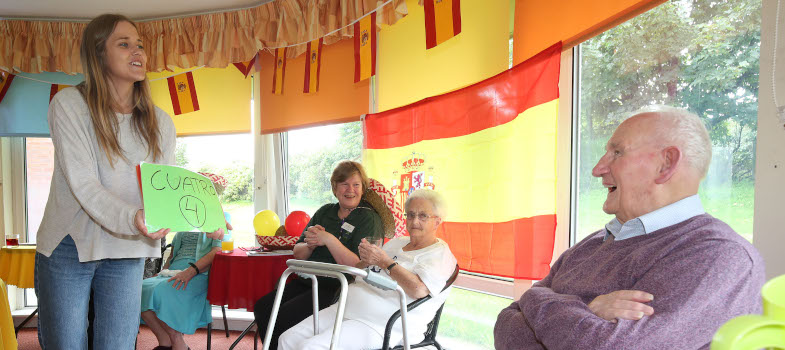
For instance, the kiss is baci, baci kisses. And we would start with that to go into the language element of the session. And this would be a nice paved, easy way to do it. When it comes to new vocabulary, again, the props are really important.
02:23
So it's really useful if we have large print elements that help the learners visualize and see those words while they hear them from us or maybe in a context like a musical context song or a game. The element of props and games can also be an element of memorisation for the learners.
02:51
So we would maybe use all these large colourful visuals, the props. and make it into a fun activity or a little game to help them memorize this word. Once we have presented the language to them, we can also maybe encourage other colleagues or family members to join in little conversations with the residents or the learners and help them really memorise those words.
03:23
It would be also quite crucial to help them absorb and memorise and use the words to always leverage on music and songs. For instance, in Italian there is quite a lot of nice tunes and nice songs that have a mix of Italian and English words in them.
03:42
A good example would be the Dean Martin songs. They are of an age or of an era that is familiar to the age group that we work with. The music always helps them put new vocabulary into a musical framework and helps them remember in an easy way and also enjoyable way, the new words.
04:06
Over a period of time, the amount of language exposure that we use in the session would
increase but still the format would be quite similar to what I have just shared with you here.
The use of music, the use of visual and the props would always be present to make the
session more accessible and more interactive for our learners.