
Three o'clock Sunday afternoon, we leave Milton Keynes with the car loaded up with equipment.
"We" are John Zarnecki, Professor of Space Science, and Karl Atkinson, PhD student, both from the OU's Planetary and Space Sciences Research Institute.
"The equipment" is an aluminium contraption about two and a half metres high, of tripod shape with a horizontal arm that can drop a sensor from various heights.
We are off to Chesil Beach, on the coast of Dorset. Why are two planetary scientists going to the Dorset coast?
Obviously, because Chesil Beach is like the surface of Titan, Saturn's largest moon!
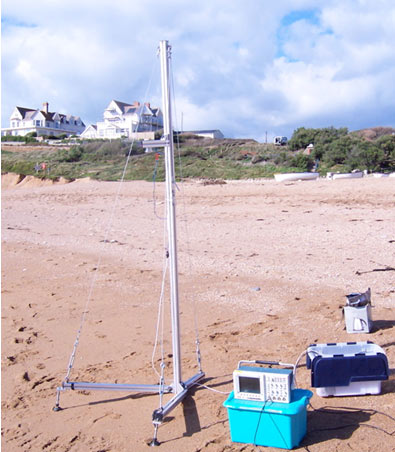
The drop rig at Chesil beach on an earlier (sunny!) trip
Let's explain. On January 14, 2005, the European Space Agency's Huygens probe landed on the surface of Titan after a seven and a quarter year, three and a half billion kilometre journey.
The first part of the probe to strike the surface was a penetrometer, part of the Surface Science Package (SSP). SSP was one of the 6 scientific instruments carried by Huygens. For about 12 milli-seconds (12/1000th of a second), the penetrometer - essentially an instrument "stick" about 10 cm long - was the only part of the Huygens Probe which was in contact with the surface, as the rest of the probe floated down to the surface under its parachute.
At the point the approximately 300 kg probe struck the surface, and from that time on, the penetrometer signal (essentially a measurement of force against time), becomes nearly impossible to interpret. But the brief 'clean' signal can give a clue as to the nature of Titan's previously unseen surface.
Karl Atkinson had started his PhD at the Open University just a few months before Huygens arrival at Titan. He had been given the task of preparing for the receipt of this precious signal (before we could even be sure that the probe would survive the perilous descent and landing).
He collected a range of reference material signatures – including those of various sands, gravels, clays and some more exotic materials. The purpose was to represent, in terms of mechanical properties for example, the range of surfaces which had been predicted for Titan. Remember that Titan is basically an icy body that was predicted to be possibly covered by a layer of organic sludge, or even lakes or seas of liquid methane.
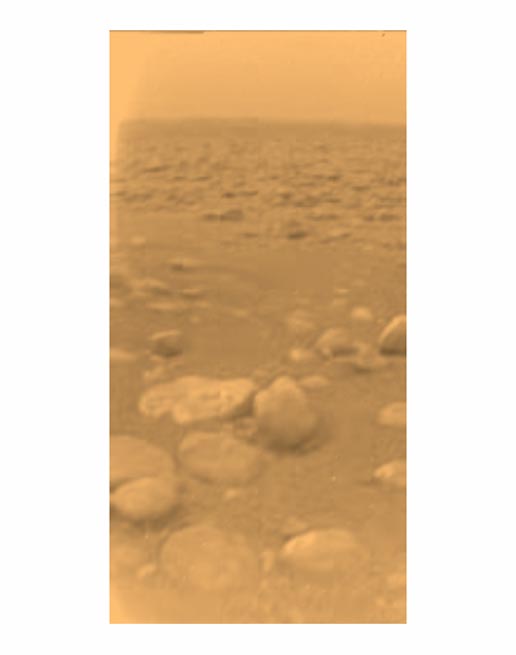
The surface of Titan imaged by the Huygens probe.
When January 14 came and went, Huygens behaved almost immaculately – and the penetrometer collected its precious data. The on-board camera showed that Huygens had landed on what looked like the shore of a dried-up lake bed. Some "pebbles" were visible sitting on top of a surface which could not be fully resolved by the camera. So what was it?
This was the question faced by Karl for his PhD project. His basic interpretation was that the penetrometer, after at first producing a brief high force signature had pushed into a soft surface. From his work in the laboratory, it seemed that the material on Titan was probably granular or grainy. Could it be Titan's version of sand or gravel, produced by the continued action of flowing liquid over the underlying bedrock - which, in the case of Titan, would be methane flowing over ice?
He produced many sample surfaces in the laboratory but knew that natural processes on Earth would be better at producing some realistic 'targets' for Titan. For example, the roughly 18 mile-long Chesil Beach offers a whole range of different local granular environments – from well-sorted cobbles through to coarse sand.
Furthermore, regions were found where the beach had distinctive layers lying on top of each other that could be seen in the penetrometry signature. Of course, Titan's surface material is 'icy' rather than 'rocky' but ice at -179oC has similar mechanical properties to rocky material on Earth's surface.
So, in the early part of 2008, a programme of simulated impacts into the range of surfaces offered by Chesil Beach was carried out. But life is never simple. Some of the data was unexpected and needed to be double-checked.
So, on 20th October 2008, we found ourselves on the beach to carry out a selection of "simulated drops" close to the actual impact speed on Titan, 4.6 metres per second. These tests were done in the face of a raging gale -inhospitable, but not quite as bad as Titan itself!
Using the beach drops and previous results from laboratory work, an estimate of the material grain size at each site was made and compared with the actual sizes observed. Accounting for the difference in density between the sand on the beach and the presumed water ice on Titan's surface, this work suggests that the grains at the Huygens landing site are similar in size to coarse sand such as that found at the western end of Chesil beach.
Furthermore, in several signatures we were able to determine the depth and thickness of distinct layers and material grading (grains being sorted with depth) caused by wave action on the beach surface. These features however are not seen in the Titan signature.
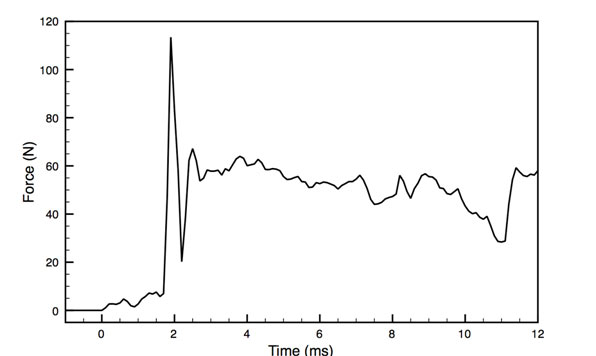
Flight data returned by the penetrometer from the surface of Titan, showing time in milliseconds against force in Newtons.
This all helps to build up the picture of what we think the surface of Titan is like and may help understand the physical processes at the landing site. Remember that these data from Huygens won't be improved on for at least 20 years - when we hope to return to Titan with an even more ambitious mission.
John and Karl were writing in support of a special edition of BBC Radio 4's The Material World, which was first broadcast on November 27th, 2008. You can listen to the full programme online.
Cassini collected
-
As Cassini reaches the end, we should prepare the next mission
Read now to access more details of As Cassini reaches the end, we should prepare the next missionWhat Cassini taught us about Saturn's moons is a start. We look back at its amazing journey, and Monica Grady argues we should now be thinking about sending the next probe.

Level: 1 Introductory
-
Why is Enceladus a possible home for life - and should we visit to find out?
Watch now to access more details of Why is Enceladus a possible home for life - and should we visit to find out?The Cassini spacecraft has had a look at Saturn's moon, and it could be perfect for life to form there. Dave Rothery reckons we need a closer look.
Level: 1 Introductory
Find out more
Stardate: Mission To Titan - our space series reported on the mission
Mission to Brighton - finding penetrometers impenterable? Try our interactive explanation.
Rate and Review
Rate this article
Review this article
Log into OpenLearn to leave reviews and join in the conversation.
Article reviews