
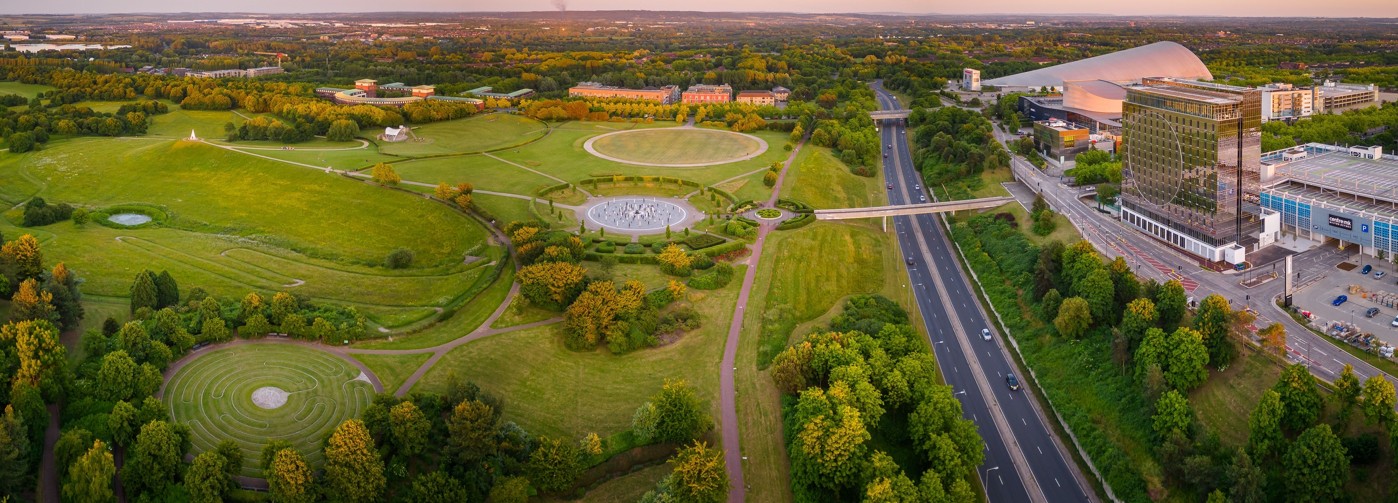
The Open University was founded back in 1969 and set up its Walton Hall campus amongst green fields in the new town (now city) of Milton Keynes, about 50 miles North West of London. This was a golden opportunity to influence the design of the thousands of new houses that were being built, making them far more energy-efficient. At that time, the idea of insulating UK houses at all was only just creeping into the official Building Regulations.
This is the fascinating story of the pioneering work of Professor Peter (Jake) Chapman, a physicist, at The Open University (OU) and John Doggart, an architect, at the new Milton Keynes Development Corporation (MKDC). This work was carried out firmly encouraged by the MKDC management.
Jake had become very concerned about UK energy policy. This was a time when North Sea oil and gas were coming on stream and there was a rose-tinted optimism about the future of nuclear power. How about just using less energy? He set out his views in his 1975 book ‘Fuels Paradise’.
At the OU Jake set up an Energy Research Group (ERG), mainly consisting of new PhD students. Through the 1970s and 1980s Jake and members of ERG worked with MKDC on a range of projects, such as:
- Analysing the performance of an active solar house (with thermal solar panels)
- Helping design and monitor nearly 200 low energy passive solar houses (where the solar gains come in through south-facing windows)
- Developing an energy rating system for new houses (the foundation of modern UK home Energy Performance Certificates).
The tests on the passive solar houses showed that they were so successful and cost-effective that MKDC introduced its own building regulations for all of the city’s new houses. They had to be insulated to standards that wouldn’t be matched in the UK national regulations until after 2000.
And bear in mind that the computer power of the period was very primitive. Home computers and spreadsheets were only just being invented!
Discover more about the project in the video below.
A vital element of the story is the genuine spirit of collaboration between academia and the architects of Milton Keynes Development Corporation. The new enthusiasm for energy-efficiency was communicated to prospective private house developers in two major exhibitions of low energy designs: HomeWorld (1981) and Energy World (1986).
I remember very fondly how a new intellectual door opened for me when I first read a copy of Jake’s best-selling Penguin book Fuel’s Paradise during my PhD research at the Cambridge Energy Research Group. In one way or another this new language of energy analysis has defined my career and life-long interests in energy teaching, energy efficiency and conservation.
Visit our Sustainability hub
-
Sustainability Hub
Learn more to access more details of Sustainability HubLearn about living sustainably with this collection of free courses, articles, interactives and films from The Open University.

Read more articles like this
-
How can we design for resilience?
Read now to access more details of How can we design for resilience?The term ‘resilience’ has become a buzzword, yet endures as a meaningful concept offering a valuable toolset for design. This article, drawn from over a decade of practice in design for resilience, will suggest how resilience concepts can be enabling for working with urgent change and sustainability in design.

-
Engaging with our environment: what are the benefits?
Read now to access more details of Engaging with our environment: what are the benefits?How can a citizen science project, a guided community walk or a park visit help our wellbeing? This article explores how to engage with the outdoors.

-
How can nature help us meet the climate challenge in towns and cities?
Read now to access more details of How can nature help us meet the climate challenge in towns and cities?At COP26 in Glasgow, we saw that scientists, politicians, and environmental activists love their jargon. Everyone who attended came away with a new climate buzzword firmly planted in their minds: nature-based solutions.

Study a free course
-
Climate change and renewable energy
Learn more to access more details of Climate change and renewable energyHuman-induced climate change and resulting extreme weather events are an increasing and serious threat to the Earth’s ecosystems. This free course, Climate Change and Renewable Energy, describes the basic science of the greenhouse effect and how it has been modified by human activities such as the burning of fossil fuels. It describes the ...

-
Environment: treading lightly on the Earth
Learn more to access more details of Environment: treading lightly on the EarthEnvironment: treading lightly on the Earth focuses on the problem of greenhouse gas emissions, especially carbon dioxide. This free course will give you an understanding of the nature and importance of carbon footprints of individuals and households. It will enable you to measure your own carbon footprint and explore what you could do to reduce ...

-
Energy in buildings
Learn more to access more details of Energy in buildingsThemes covered in this free course, Energy in buildings, include reducing heating demand in buildings, heating systems and fuel emissions, and reducing electricity use by appliances. The course looks at the importance of energy in buildings in the UK, investigate heat loss and how to prevent it, ways of increasing building efficiency, ...

Visit our Systems thinking hub
-
Systems Thinking Hub
Learn more to access more details of Systems Thinking HubWelcome! Check out our fantastic range of FREE resources on systems thinking in practice.
Rate and Review
Rate this article
Review this article
Log into OpenLearn to leave reviews and join in the conversation.
Article reviews