
Find out more about The Open University's Science courses and qualifications
The microwave cooker. Handy for all manner of food-related tasks. It's hardly standard equipment for the science laboratory, is it? Perhaps it should be. Watch Cosmic Chocolate:
The explanation
If you've watched the video above you might be puzzled. How did we measure the speed of light using chocolate and a microwave?
It’s all to do with waves and wavelengths. Microwaves are a form of electromagnetic radiation, just like light. They travel at the same speed, but with different wavelengths and frequency. We need to measure the wavelength and get the frequency – then we can get the speed.
So – how do we get the wavelength? The key is to stop the hot plate from turning. The peaks and troughs of waves in a microwave are actually fairly stable and stay in the same place in the microwave.
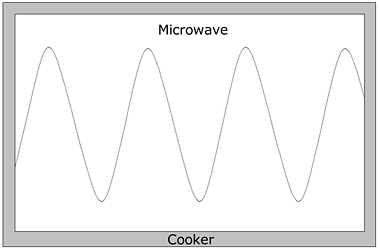
Where the wave hits the chocolate, it causes the chocolate to melt. When the hot plate is turning, these melt points are distributed across the bar of chocolate, so the whole bar warms up fairly evenly. However, when the plate is static the melt points remain in the same place.
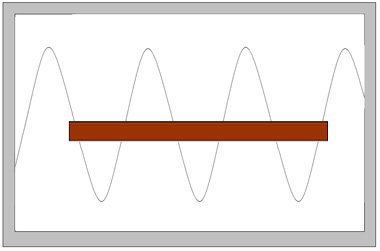
The distance between the melt points parts of the chocolate is half the wavelength of the microwave.
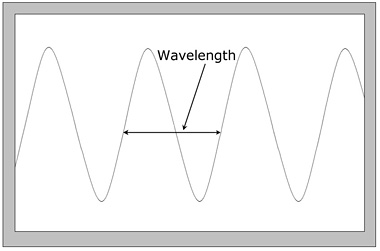
Now there’s a very important physics equation which states the relationship between wave length, frequency and speed:
wave speed = frequency x wavelength
In the video the melt points on the chocolate are 6cm apart – which is half the wavelength – so the wavelength is 12cm.
From the back of the microwave unit we have the frequency of the microwave: 2,450Mhz. So that means...
speed of the wave = 12 X 2,450,000,000
speed of the wave = 29,400,000,000 cm per second.
That’s the speed of the microwave and also the speed of light (well, as fast as light would travel in your microwave).
The actual speed of light is 29,979,245,800 cm per second.
What could you do next?
- Do this at home. Just make sure you take off the foil wrapper and make sure you don’t burn the chocolate – it can get very hot, very quickly.
- Can you think of other ways of getting a more accurate measure? There are other electromagnetic waves out there.
- Post video responses of other chocolate experiments (please – no dangerous microwave experiments),
Study a free course
-
Particle physics
Learn more to access more details of Particle physicsThis free course, Particle physics, will give you an overview of current concepts and theories in the field. You will learn about the fundamental components of matter – known as leptons and quarks – and the composite particles, such as protons and neutrons, which are composed of quarks. You will see that all particle reactions may be described ...

-
Basic science: understanding experiments
Learn more to access more details of Basic science: understanding experimentsDevelop science-based skills through simple and exciting physics, chemistry and biology experiments.

-
Electromagnetism: testing Coulomb’s law
Learn more to access more details of Electromagnetism: testing Coulomb’s lawThis free course explores Coulomb’s law, the physical law that governs the force between electric charges, and shows how it can be verified experimentally. As a prerequisite you will need some mathematical knowledge of vectors. This free course is an adapted extract from the Open University course SM381 Electromagnetism.

Rate and Review
Rate this video
Review this video
Log into OpenLearn to leave reviews and join in the conversation.
Video reviews