513 search results

Gravity die casting
Science, Maths & Technology

Gravity die casting

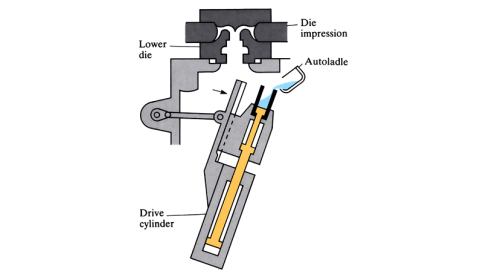
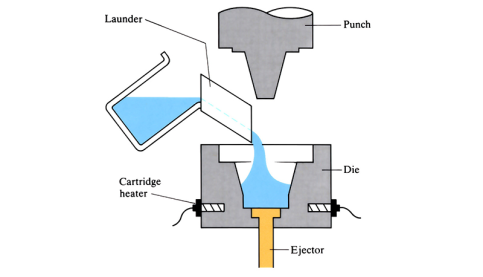
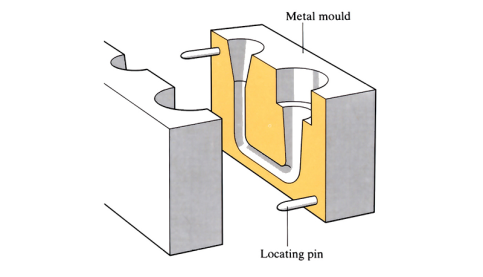
...sand casting. Steel castings have been shown to be 15–20% cheaper than comparable sand castings. Cost of gravity die castings is comparable with other casting processes (see diagram). Typical products include cylinder heads, wheel hubs and pistons (non-ferrous), crankshafts, disc-brake parts and hydraulic components (ferrous) for the......
Ceramic mould casting
Science, Maths & Technology

Ceramic mould casting

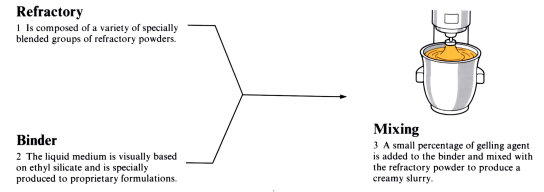
...casting, etc. (Shaw process), aluminium alloy impellors, torque converters and valve parts (Plaster process). Materials: Plaster sands are only suitable for low melting point materials such as Al and Cu based alloys, and gold and silver jewellery alloys. Insufficient drying of plastic moulds can lead to hydrogen pick-up in aluminium alloys, causing porosity. Refractory...
Resin shell casting
Science, Maths & Technology

Resin shell casting

...sand casting. Limits of ±0.25 mm can be achieved on small castings up to 100 mm in size. Cores should generally be avoided wherever possible. Only 1˚ of taper is required compared with 2 - 3˚ for sand castings. Faces up to 18 mm deep can be produced with virtually no taper. Use of fine grained sands produces good surface finishes. A shell moulding, ......
Low pressure die casting (counter-pressure casting)
Science, Maths & Technology

Low pressure die casting (counter-pressure casting)

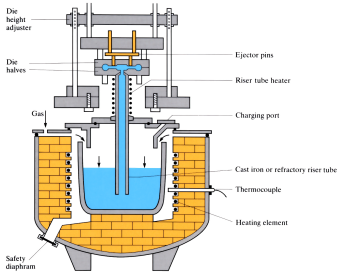
...casting. Sand or shell cores can be used in the dies to produce internal cavities, but usually require a refractory coating to prevent metal penetration under pressure. Castings have no runners or feeders in the true sense, and hence high yields (80–90%) and low remelt ratios are obtained which, coupled with reduced fettling, gives a high energy saving. Casting machines...
Pore-free die casting (active atmosphere casting)
Science, Maths & Technology

Pore-free die casting (active atmosphere casting)

...welding to be carried out using conventional argon aluminium welding equipment. This means large products can be made by welding together several component die castings. Lack of porosity means casting around inserts causes fewer problems than with high pressure die casting. See Also: High pressure die casting, Acurad process, Hot forging (closed die) and ......
High pressure die casting
Science, Maths & Technology

High pressure die casting

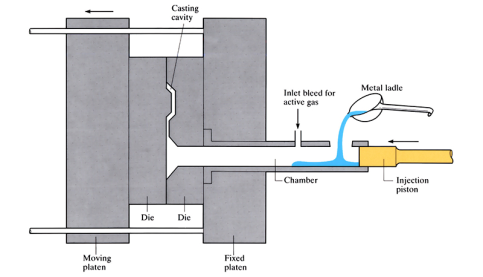
...casting is carried out in zinc-, magnesium- and aluminium-based alloys. The most popular zinc-based alloys (known as Mazak) contain 3.8–4.3% aluminium and 0.10–1.25 wt% copper, with tensile strengths of 293–355 MPa, and elongations of 3–4%. Zinc alloys have a higher impact strength than die cast aluminium alloys. There are six main aluminium die ......
Squeeze casting and squeeze forming
Science, Maths & Technology

Squeeze casting and squeeze forming

...aluminium casting and forging alloys are used commercially, but there is no reason why the process cannot be used with most metals and alloys. Secondary quality aluminium casting alloys can be used without coarse iron aluminide needles impairing mechanical properties. Process produces a fine grain structure (typically 120 μm) with small dendrite cells (typical arm...
Full mould casting (evaporative pattern)
Science, Maths & Technology

Full mould casting (evaporative pattern)

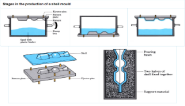
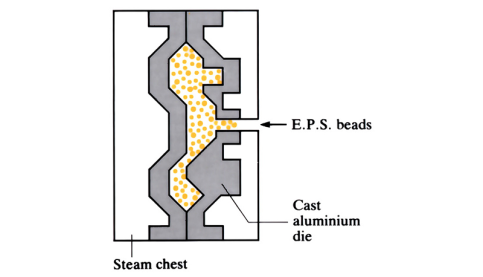
...casting is removed...1. Inject polystyrene beads into a heated aluminium die. Inject steam into pattern, from a steam chest, to fuse and expand polystyrene beads. [Diagram to demonstrate Full mould casting (Evaporative pattern) - see article] 2. Cool die, open, eject pattern and store for 30 days. [Diagram to demonstrate Full mould casting (Evaporative pattern) - see...