513 search results

Vertical high pressure die casting
Science, Maths & Technology

Vertical high pressure die casting

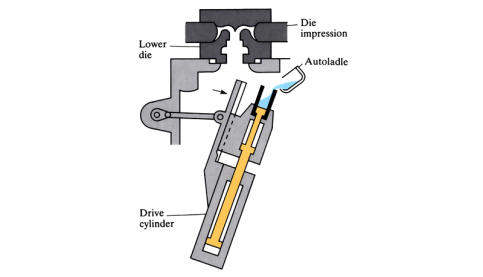
...problems due to air entrapment and prevents spray injection into the die cavity. Design: Used for similar applications to those used for conventional high pressure die casting. The major application is for automobile wheel rims in aluminium alloys. See Also: High pressure die casting, Low pressure die casting, Low pressure sand casting and ......
Rotational moulding (Rotational or rotary casting)
Science, Maths & Technology

Rotational moulding (Rotational or rotary casting)

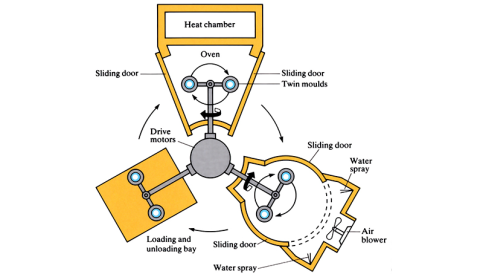
...Casting Processes] Moulding Procedure: [Casting Processes] Rotational casting of PVC plastisols and powdered polymers, showing the sequence of operations from left to right. Add a measured amount of plastisol or powder to mould. Close mould. Rotate around two or more axes. Distribute plastisol or powder evenly on mould surface. Heat to fuse while rotating. Open mould....
How can you use sand to store energy?
Science, Maths & Technology

How can you use sand to store energy?

...sand and sunshine - to generate power cleanly and efficiently...[Rafał Sonik on an Abu Dhabi sand dune] Ralf Sonik fluffs a sand dune in Abu Dhabi Researchers in Abu Dhabi are testing a pilot device that can store solar energy in sand to improve the efficiency of power plants and provide energy at night. The technology, developed at the Masdar Institute of Science and...
"V" Process (Vacuum sealed moulding process)
Science, Maths & Technology

"V" Process (Vacuum sealed moulding process)

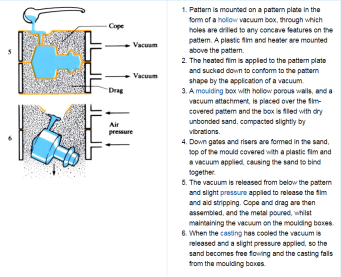
...cast aluminium are cheaper than for “bonded” sand moulding and last longer, since the sand does not come into contact with the pattern. Gating systems should allow the cavity to be filled rapidly. Vents and risers must be located in such a way that the unfilled portion of the casting cavity is at atmospheric pressure, to allow the gases formed in the initial stages to...
Anodising
Science, Maths & Technology

Anodising

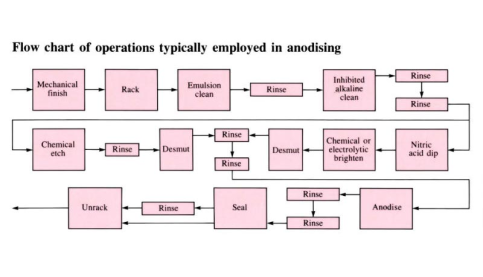
...castings depends on the casting method used, i.e. sand, gravity or die casting. Only a small range of alloy compositions can be used for decorative purposes, because the Al-(6-12%) Si alloys, mainly used for die casting, become grey after anodising, due to the high silicon content. Other materials which can be anodised include magnesium and titanium alloys. Design:...
Article 10 mins
Pressureless sintering
Science, Maths & Technology

Pressureless sintering

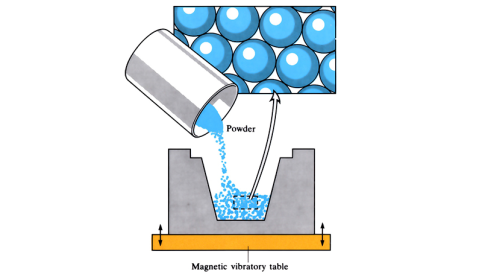
...filters and porous bearings. Filters require a high permeability, large percentage of controllable porosity and pore sizes. Depending on application, filters also require interconnected porosity, which is maximised by use of spherical powders. See Also: Slip-casting, Cold pressing and sintering of powders, Hot isostatic pressing, Sand casting and Gravity die casting....
Shot blasting
Science, Maths & Technology

Shot blasting

...cast iron (size range 2.8 µm down to 40 µm) “sand”: non-metallic abrasives such as aluminium oxide or silicon carbide “shot”: same material as grit, but spherical in shape, or cut wire. Materials: Although virtually all metals can be shot blasted by at least one of the available processes, the abrasive medium must be carefully selected for soft, ductile metals...
Article 10 mins
CLA – Hitchiner process
Science, Maths & Technology

CLA – Hitchiner process

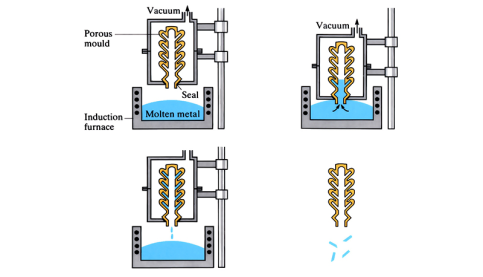
...alloys. Design: Gates (6–12 mm in length) are removed at a rate of 600 per hour to an accuracy of ±0.012 mm. Thin wall castings can be produced (0.28–0.9 mm). Increased number of parts per sprue, e.g. one component increased from 24 pieces up to 60 pieces per sprue. See Also: Investment casting, Low pressure sand casting and Vertical high pressure die casting....