425 search results

The geology of Northern Ireland
Science, Maths & Technology

The geology of Northern Ireland

...carbon was preserved at this time and in these swamps. After the Carboniferous, in the Permian and Triassic times, dry conditions prevailed with more desert deposits and hypersaline lakes forming as seen in the salt deposits near Carrickfergus, County Antrim. Sea levels rose again in the Jurassic period with shallow seas containing ammonites recorded in Larne. During the...
Ceramic mould casting
Science, Maths & Technology

Ceramic mould casting

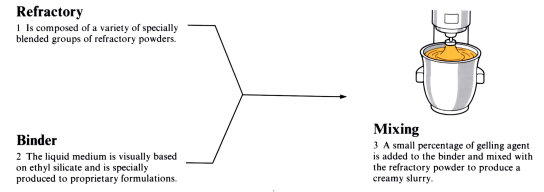
...carbon and alloy steels, and Cu/Be alloys. The Shaw process can produce castings without the usual casting defects found in other processes. Benefits include: high resistance to hot tearing casting free from gas holes inclusion-free castings process permits “natural feeding” of the casting. Design: Shaw process; complex 3D components moulded in two or more parts....
Magneform (electromagnetic assembly and forming)
Science, Maths & Technology

Magneform (electromagnetic assembly and forming)

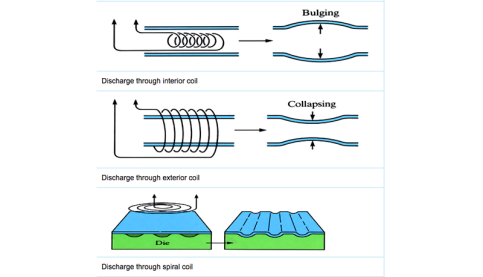
...carbon steel. The resistivity of material is best if it is less than 15 x 10-6 Ω cm. Materials of poor conductivity, such as stainless steels, can be formed by using a highly conductive driver, such as aluminium sheet, or a specially built high frequency machine. Different materials can be assembled together, such as metal rings on to plastic, glass, composites and...
Electro-slag welding
Science, Maths & Technology

Electro-slag welding

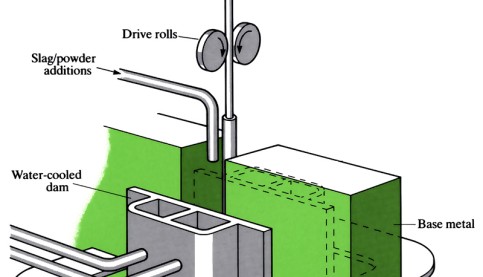
...carbon steel, low-alloy high strength steel, and quenched and tempered low-alloy steel. Can also be used to weld stainless steel and aluminium alloys if required. The weld metal acquires the structure of a casting, wherein the sizes and orientations of the grains are governed by heat removal characteristics. Long columnar grains can be formed with microsegregation and...
Cold forging
Science, Maths & Technology

Cold forging

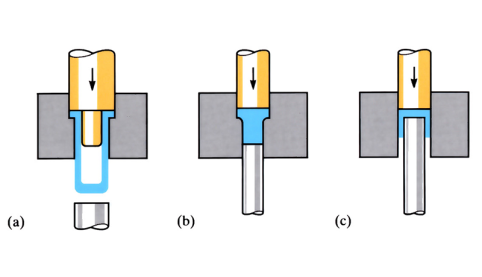
...carbon mild steel (<0.2 wt% C) which is used to produce a wide range of components, mainly in the automotive and bicycle component industries. Mild steel has to be annealed before cold forging and at interstage processes. Cold forging causes strain hardening in the materials, resulting in increases of 30–120% in tensile strength and 100–300% in yield strength values....
Article 5 mins
Cold Pressing and Sintering of Powders
Science, Maths & Technology

Cold Pressing and Sintering of Powders

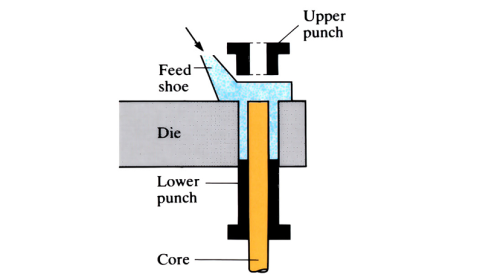
...carbon), 0.3–1.0 wt%; copper (infiltration), 1.5–11.0 wt%; nickel, 1.0–8.0 wt% Typical sintered properties of steels are as follows: Tensile strength (MPa) Yield strength (MPa) Elongation (%) Fe-0.5C (density 6.8 g cm-3) 296 193 3.5 Fe-2.7Cu-0.15C (density 6.8 g cm-3) 255 159 7.0 Fe-2.7Cu-0.45C (density 6.8 g cm-3) 427 310 3.0 The main additions to aluminium alloys...
How does nature tell the time?
Nature & Environment

How does nature tell the time?

...Carbon, ISBN 0963831429 Links you can surf Information on time from ancient calendars to the atomic age For more information on Cathy Groves and her research If you want to know the time around the world! Also on the Ever Wondered site:You can join Penny smith as she asks are we really living life 24-7? Or if you’ve always wanted to stop the march of time join Edward...
Powder Forging / Hot pressing
Science, Maths & Technology

Powder Forging / Hot pressing

...carbon steel, which can be hardened and tempered to give mechanical properties as good as, or better than, wrought alloy. Other steel compositions include steels suitable for carburising or through-hardening applications, e.g. Fe-1.8Ni-0.45Mo-0.2Mn-0.35C with a tensile strength of 930 MPa and elongation of 13%. Pre-alloyed aluminium alloy powders include the following...