513 search results

Toyota diffusion (TD)
Science, Maths & Technology

Toyota diffusion (TD)

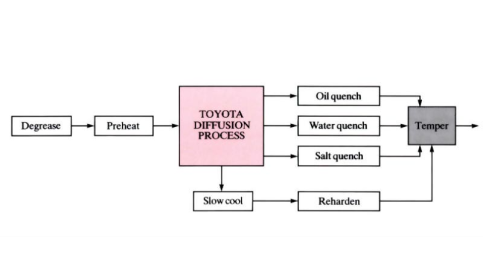
...casting, and rubber and plastic moulding. Tool steels include the following: H13 hot working tool steel (Fe–5Cr) D2 ASP30, produced by hot isostatic compaction. The coating grows by reaction of the carbide-former and carbon atoms diffusing from the matrix. The hardness of the vanadium carbide layer is in excess of 3000 VPN, which is higher than most other similar...
Hot isostatic pressing (HIP)
Science, Maths & Technology

Hot isostatic pressing (HIP)

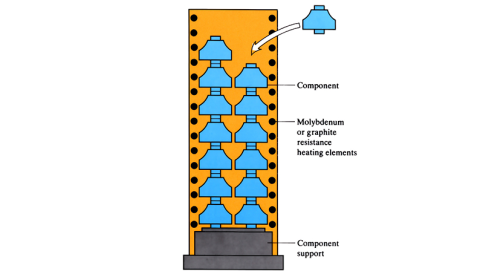
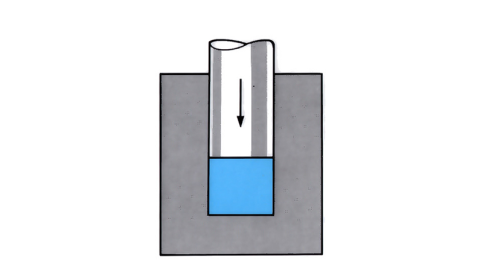
...cast or sintered components. The addition of argon gas to the furnace helps to apply isostatic pressure to the component/s. The pressure and heat help to fill any pores on the surface of the component, thus optimising material properties and density...1. Load components into the furnace. [Diagrams to demonstrate 'Hot isostatic pressing (HIP)'] 2. Load furnace into...
Manufacturing
Science, Maths & Technology

Manufacturing

...casting is a typical example of a permanent pattern process, where a pattern is placed into a special casting sand to form the right shape of cavity. Permanent pattern processes are usually cheaper than other methods, especially for small quantity production or 'one-offs', and are suitable for a wide range of sizes of product...Manufacturing: 2.3.2 Permanent mould - In...
Level 1: Introductory 20 hrs
Isothermal precision forging
Science, Maths & Technology

Isothermal precision forging

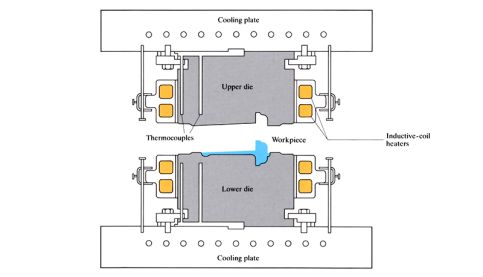
...aluminium alloys, titanium alloys, iron-12% chromium alloys and nickel-based superalloys. Mechanical properties of isothermally forged alloys are similar to conventionally forged properties. Fine grain sizes and minimal grain flow can be achieved. [Forming processes] Design: Isothermal forgings are subject to some design constraints: no undercuts or side pockets. Process...
Plasma arc spraying
Science, Maths & Technology

Plasma arc spraying

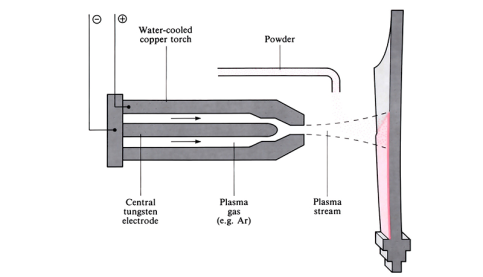
...sand blasting machines, cold deep-drawing dies and turbine blades. Materials: Since the transferred arc process is a true welding process, it uses alloys of iron, cobalt and nickel. The non-transferred arc process is most suitable for non-weldable materials and substrates that cannot be coated by weld deposits. This process uses higher melting point materials such as...
Osprey process
Science, Maths & Technology

Osprey process

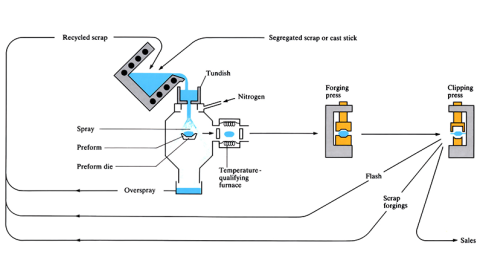
...Aluminium alloys can be produced, e.g. Al-4%Cu alloy, as can new compositions and rapidly solidified materials. Alloy steels and stainless steels are preformed on the Osprey Process. Cu-10%Sn bronze preforms with grain sizes of <0.0015 mm can be hot worked without cracking. Heat treatment times for homogenisation are substantially reduced. High temperature nickel- and...
Hot forging (closed die)
Science, Maths & Technology

Hot forging (closed die)

...aluminium alloy forgings with rating of 750–65,000 tons. Production rates vary with size of forging and degree of automation: crank presses with auto-transfer 300–600 parts h-1 hot formers (e.g. Hatebur) totally enclosed dies (without flash) 4000–10,000 parts h-1 Die lives vary with type of material being formed. The higher the forging temperature, the lower the die...
The Material World: On Chesil Beach (getting closer to Titan)
Science, Maths & Technology

The Material World: On Chesil Beach (getting closer to Titan)

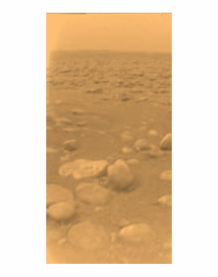
...aluminium contraption about two and a half metres high, of tripod shape with a horizontal arm that can drop a sensor from various heights. We are off to Chesil Beach, on the coast of Dorset. Why are two planetary scientists going to the Dorset coast? Obviously, because Chesil Beach is like the surface of Titan, Saturn's largest moon! [The drop rig at Chesil beach on an...