513 search results

Reaction injection moulding (RIM) and Reinforced reaction injection moulding (RRIM)
Science, Maths & Technology

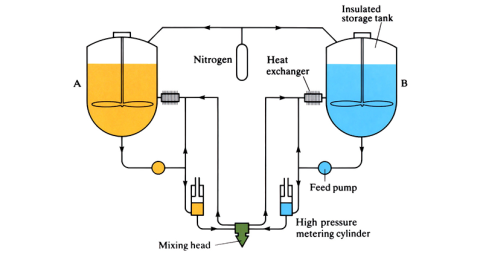
Reaction injection moulding (RIM) and Reinforced reaction injection moulding (RRIM)

...aluminium, zinc alloy or even epoxy for small production runs and prototypes. Cycle times depend on material and component size and shape, but are comparable with injection moulding for small parts. Above 0.5 kg RIM is better than injection moulding; for a 5 kg part a 1 min part-to-part demould time is typical. A PTFE or silicone wax mould-release agent (MRA) was...
Cold forging
Science, Maths & Technology

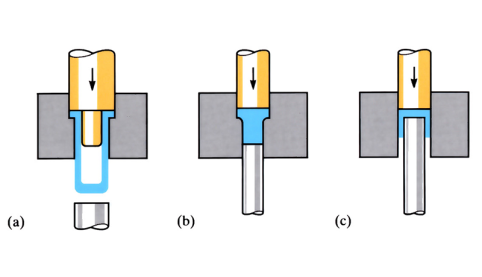
Cold forging

...aluminium into collapsible cans, canisters for food or electric-torch cases. Materials: Not all materials can be cold formed. Those that can tend to be the soft metals. Lead, tin and aluminium are used for impact extrusion of collapsible tubes, and canisters are produced by the Hooker process. Brass is used for the production of shell and cartridge cases. Aluminium and...
Article 5 mins
Duchess of Malfi: Deconstructing the play
History & The Arts

Duchess of Malfi: Deconstructing the play

...cast and crew as they analyse the language used by John Webster, as well as exploring different ways of understanding the text and converting his words into a performance. This material forms part of The Open University course A230 Reading and studying literature... The Duchess of Malfi A brief introduction to the play. Understanding Webster’s text The cast discuss...
Ice Cold In Alex
Science, Maths & Technology

Ice Cold In Alex

...sand dunes. Whew! A close shave, what? But relief turns to despair when the ambulance crew in Ice Cold in Alex find that their truck just doesn’t have the power to get out of the gully. What to do? The truck engine’s boiling over, the sun’s blazing down and all they want to do is have an ice cold beer in Alexandria. Of course, they have to use the crank shaft of...
Brazing
Science, Maths & Technology

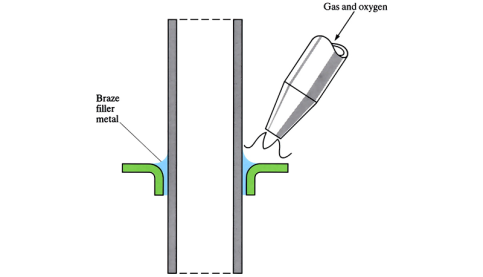
Brazing

...aluminium and aluminium-based alloys, with Zn, Cd or Al-Si systems Fluorine/boron compounds 600 - 1000˚C particularly with refractory oxides Design: Joint clearance is critical, depending on brazing materials, surface condition, degree of alloying and length of joint. Recommended joint clearances vary from interference fit to 0.6 mm. Lap joints are preferred to butt...
Article 10 mins
Injection moulding
Science, Maths & Technology

Injection moulding

...casting, 0.02–1 MPa; high pressure die casting, 3–200 MPa). Machines are classified according to the locking force of the platens and can vary from 1–3000 tonnes. Most machines lie in the range of 50–250 tonnes. The higher the locking force, the larger the projected area of the component that can be produced. Locking can be either mechanical or hydraulic, although...
Injected metal assembly (Liquid riveting)
Science, Maths & Technology

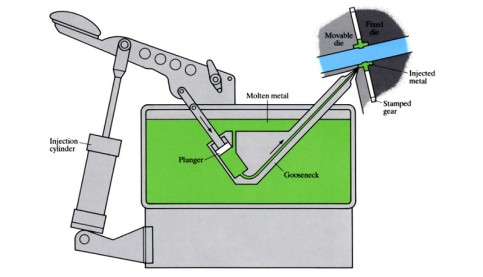
Injected metal assembly (Liquid riveting)

...casting is a simple joining/assembly technique where components are accurately positioned and metal is injected into the cavity between the components and a die, solidifying almost instantaneously. The join, which may be stronger than the component itself, depends on the mechanical locking action and shrinkage of the injected metal, not adhesion...[Images to demonstrate...
Metal Spinning / Flow Turning
Science, Maths & Technology

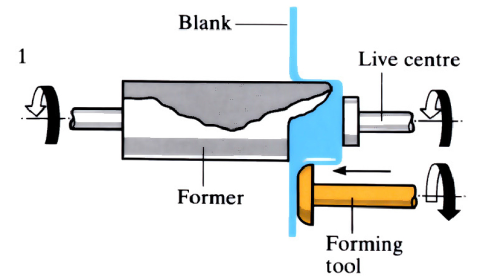
Metal Spinning / Flow Turning

...aluminium and its alloys, copper, 70-30 brass, mild steel, stainless steel and titanium. Mild steel up to 9 mm thick can be spun. Stainless steel up to 3 mm thick can also be spun. Design: In general, the larger the component, the more favourable metal spinning becomes. Thicknesses between 0.25 and 9 mm can be spun, depending on the material. Blank diameters are usually...