1,275 search results

Diagramming for development 1: bounding realities
Digital & Computing

Diagramming for development 1: bounding realities

...adapted from an image by Angela Sevin: the original can be seen at http://www.flickr.com/photos/angela7/261618376 [Details correct as of 24 October 2011] Except for third party materials and otherwise stated (see terms and conditions), this content is made available under a Creative Commons Attribution-NonCommercial-ShareAlike 4.0 Licence. Every effort has been made to...
Starting with psychology
Health, Sports & Psychology

Starting with psychology

...et al, devised a number of split brain experiments using people who had had split brain surgery as participants and comparing their responses to people who had not had this surgery. In one experiment the split brain participant was blindfolded and given objects to explore with their left hand. Information from the left hand goes to the right hemisphere but speech is...
Level 1: Introductory 5 hrs
What can philosophy tell us about race?
History & The Arts

What can philosophy tell us about race?

...adapted extract from the Open University course DA223 Investigating philosophy....What can philosophy tell us about race?: Introduction - This free course introduces you to the philosophy of race and explores the ways in which philosophy impacts our understanding of the social world. You will explore answers to two central questions: What is race? What is racism? Along...
The business of football
Money & Business

The business of football

...adapted from Everard et al., 2009, pp. 88–90 and Everard and Wilson, 2004 Audio-visual Audio: The Managers, from BBC World Service © BBC 2014 All other video/audio: © The Open University Don't miss out: 1. Join over 200,000 students, currently studying with The Open University - http://www.open.ac.uk/ choose/ ou/ open-content 2. Enjoyed this? Find out more about this...
Level 1: Introductory 15 hrs
What are waves?
Science, Maths & Technology

What are waves?

...adapted extract from the Open University course S111 Questions in science...What are waves?: Learning outcomes - After studying this course, you should be able to: understand the types of wave understand the properties of waves...What are waves?: 1 How do you make a wave? - Waves on the surface of the ocean are caused by winds that displace the surface. The same applies...
Level 1: Introductory 3 hrs
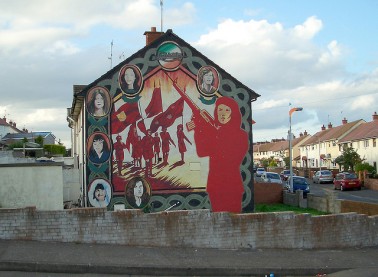
Murals in Belfast
OpenLearn Ireland

Murals in Belfast

...may evolve rather than disappear, not the least because they are an increasingly popular tourist attraction. This article is an adapted extract from the free course 'Political Ordering', which is adapted from the Open University course Introducing the social sciences (DD102). Mural photographs © Bill Royston Painting from the Same Palette © Mark Ervine and Danny Devenny...
Crimes of the powerful
Society, Politics & Law

Crimes of the powerful

...adapted from Mclaughlin, E. and Muncie, J. (eds), 2001)...Crimes of the powerful: Dominant ideologies - One of the central starting points for those who research crimes of the powerful is the importance of first examining and then questioning dominant ideologies. ‘Dominant ideologies’ can be defined as ‘shared ideas or beliefs which serve to justify the interests of...
Level 3: Advanced 2 hrs
International relations: exploring territorial divisions
Society, Politics & Law

International relations: exploring territorial divisions

...adapted extract from the Open University course D818 MA International relations part 1...International relations: exploring territorial divisions: 1 How is the world divided territorially? - If we consider the political map of the world at different points in history, we are presented with a fluctuating picture that shows a range of different territorial units forming,...