

3 Case study: Innocent Drinks
Bearing all of this in mind, the course will now focus on a company that Chris singles out as particularly good at verbal identity: Innocent Drinks.
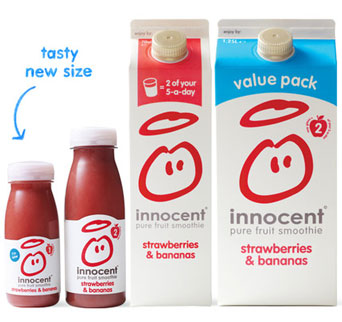
Innocent Drinks (‘Innocent’) is a company headquartered in the UK that started out in 1999 making smoothies (thick, pulpy fruit juices) and now also makes juice, noodle pots, vegetable pots, and children’s versions of its drinks. The products are sold internationally in many food outlets, including supermarkets, coffee shops and newsagents. Originally founded by a group of three friends, the company is now mostly owned by The Coca-Cola Company.
Activity 4 Formal and informal language
Before you look in detail at Innocent’s verbal identity, take a look at the features of language below (based on Biber, 1988). Sort them into features that in English can be associated with formal language, of the kind you might use, for example, in writing reports or in academic essays, and informal language, of the kind you would use for example when talking to close friends.
Looking at the list of informal features, can you think of a particular type of language/discourse that these might be very common in?
Discussion
These informal features tend to be associated with spoken language (Biber, 1988). When we speak, especially when we speak to each other, we tend to speak in short sentences that may seem incomplete if compared to written phrasing. We use lots of fillers, imprecise words, contractions and incomplete sentences, and address each other directly with ‘you’. Of course, there is a lot of variation in speaking styles, and there is no strict one-to-one correspondence. Especially considering other languages and cultures, such lists can include different components. For example, in many languages (including French, German, Hungarian and Farsi) in/formality is also represented in the choice of informal or formal second person pronoun/ term of address – the so-called tu/vous distinction.