

2 Where is organisational culture?
Having looked at what organisational culture is, at this point it might be helpful to think about how and where we can see it. How can we pinpoint or identify the culture of a specific organisation? This is an important question if you want to introduce changes.
Schein (2016) argues that organisational culture is embedded at three different levels, in:
- artifacts
- espoused beliefs and values
- basic underlying assumptions.
Only the top level, artifacts is immediately observable. Artifacts comprise ‘visible and feelable phenomena’ (Schein, 2016) such as the physical environment, language, style as in clothing, stories told in and about the organisation, mission and vision statements, overt behaviour, and so on. The middle level, espoused beliefs and values, reflects the ideals, goals, values, aspirations and ideologies of the group: these may or may not be congruent with (i.e. in agreement with) the group’s actual behaviours. The lowest level, basic underlying assumptions, is almost impossible to detect as this comprises the unconscious, taken-for-granted beliefs and values which determine individuals’ behaviours, perceptions, thoughts and feelings. This can make changing an organisation’s culture quite difficult but, as you will see later on, this is precisely where language analysis can be incredibly helpful.
The metaphor of the Lily Pond
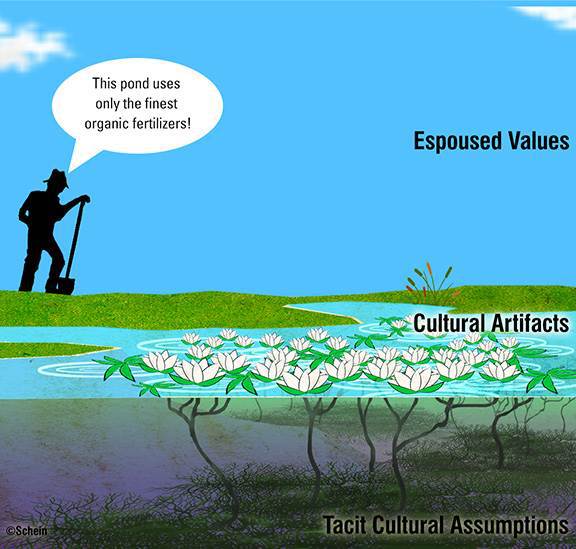
Schein summarises their three-level model with a metaphorical lily pond, describing this as follows:
We can summarize this three-level model with a metaphoric lily pond. The blossoms and the leaves on the surface of the pond are the ‘artifacts’ that we can see and evaluate. The farmer who has created the pond (the leadership) announces what he expected and hoped for in the way of leaves and blossoms and will provide publicly accepted beliefs and values to justify the outcome. The farmer may or may not be consciously aware that the outcome is really a result of how the seeds, the root system, the quality of the water in the pond, and the fertilizers he put in combined to create the blossoms and leaves. This lack of awareness of what actually produces the results may not matter if the announced beliefs and values are congruent with how the leaves and blossoms turned out.
Pause a moment to reflect on Schein’s model. Does this resonate with any organisation you’ve been a member of? Does the model help to shed light on what was going on in the organisation’s culture – at both overt and hidden levels?
You may be interested in a relatively recent addition to the terminology in the field of organisational culture studies – that of ‘culture washing’. In the same way as the term ‘green washing’ refers to a misleading impression of an organisation or product being environmentally sound, culture washing refers to organisations which claim they have a healthy internal culture when the reality is otherwise. For example, a company claiming a healthy work life ethic for employees but where the reality is that workers feel they have to be seen to be at their desk until their manager leaves, whatever time this is, could be said to display culture washing. In linguistic terms, culture washing could be said to be in place if the organisation claims equal terms of address for all, but in fact managers are referred to by their title and family name and lower level employees by their given name only. (See this site to read more on culture washing in the world of work.)
Next, you’ll look at a case study showing how language analysis can play a part in helping to influence an organisation’s culture.