

3 Joint attention and common ground
An important social situation for language learning is where infants share attention with another person on an object or action of mutual interest. For example, when a child is playing with a toy and their mother says ‘Wow! That’s a wooden block’. In this situation infants come to understand that the parent is looking at the toy, and the parent knows the infant is looking at the toy, and they both ‘know together’. They have joint attention.
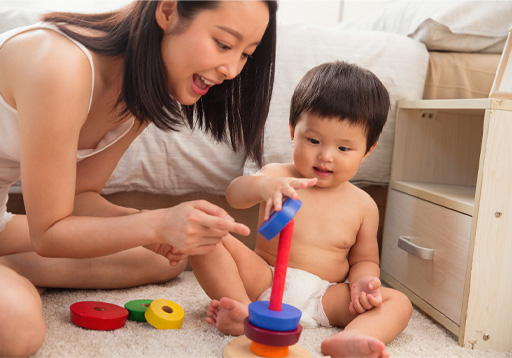
Experimental evidence shows these episodes of joint attention help children learn language by making it more obvious what everyone are speaking about (recall the challenge of what words refer to from Session 1). In combination with other social cues like following eye-gaze, tone of voice and pointing, joint attention makes it clearer to infants when speech is intended for them and when it is not (Moore et al., 1999).
Adults will often unconsciously adapt their communication style depending how much they think the infant knows about the object in joint attention. When adults assume infants don’t know much, then they will gesture more, repeat themselves and use exaggerated movements (Dimitrova and Moro, 2013). In this course you will come across more examples of how adults scaffold children’s language development by adapting their interactions to the child.
As adults and infants interact over the course of conversation they build common ground together. At a basic level this requires both partners to keep a track of their experience together and remember what is new information and what is old. In one experiment, when a researcher said to 12- and 18-month-old infants ‘Oh, wow! That’s so cool! Can you give it to me?’ while gesturing ambiguously in the direction of three objects, infants handed over the object that is new to the adult even though it was not new for the infants (Tomasello and Haberl, 2003). Building common ground together makes language work more efficiently. For example, in conversation, the first time we mention an object we might say ‘pass me the cuddly toy with a pink nose’ but later on just say ‘pass me it’. It is only because we have built up common ground together that we both know what ‘it’ refers to. The more common ground we have the less we need to say.
The ability to appreciate another person’s perspective is also rapidly developing in the first years of life (Lempers et al., 1977). This social ability has fundamental implications for language learning because words and phrases are invitations to see the world from a particular perspective. For example, a scene where a dog is running behind a cat can be equally described as ‘a dog chasing a cat’ or ‘a cat fleeing a dog’ depending on how one wants to construe the event. Thus, a speaker’s choice to use one word or phrase rather than another signals a different meaning and often communicative a different perspective too (Clark, 1997).
Activity 2 What are babies interested in, and why is tuning into a child’s interests important?
Before you watch the video, write in the box below why you think joint attention is important in language learning.
Then watch Video 4.
Video 4 What is my baby interested in?
Discussion
The experiment demonstrated why joint attention is important for language development. More natural observations of children’s behaviour reinforce the same point. Researchers observed 24 infants between 9 and 15 months of age, measuring them every 2 months on their level of attentional engagement, eye-gaze and point following, imitations of two different kinds of actions on objects (Carpenter et al., 1998). They found that the amount of time infants spent in joint engagement with their mothers and the degree to which mothers used language that was attuned to their infant’s focus of attention predicted infants’ earliest linguistic communication. Brooks and Meltzoff (2005) also found a strong association between gaze-following behaviour at 10–11 months and later language scores at 18 months. Others have found imitation ability at 20 months is associated with language production ability at 44 months and the amount of infants’ eye-gaze-following at 6 months has been shown to correlate with their vocabulary size at 18 months.
Today, there is concern that digital screen use by infants may have displaced some of these social interactions and may have a detrimental effect on language outcomes. In 2020, preschoolers were estimated to spend 2.5 hrs per day on screens (Rideout and Robb, 2020). Interestingly, it seems time spent on screens does not have a simple negative effect on language or literacy outcomes, rather it is how children spend that time (Dore et al., 2020). When infants view high-quality educational content with other engaged adults (i.e. with joint attention on the screen) the negative effects of screen use can be diminished or even reversed (Madigan et al., 2020).