

2 From brain to lungs to lips
As you start to explore children’s first utterances, it is helpful to understand more about what it takes to produce the sounds of language.
To begin speaking involves many areas of the brain working together in a highly coordinated fashion. The initial impulse to talk follows complex pathways through the brain, which organise the information needed for the articulatory system to make the sound (Fujii et al., 2016). This includes an estimate of where the articulatory apparatus currently is (is the tongue high/low; breathing in/out?) to calculate backwards how far and how quickly the speech apparatus needs to change to reach the target position.
Speech signals from the brain then synchronise a contraction of the diaphragm, abdomen, chest muscles and rib cage to force a pressurised column of air to move from the lungs. When this pressure wave hits the vocal folds, it causes them to vibrate rapidly, opening and closing between 110 and 300 times a second (slower for men = lower pitch; quicker for women and children = higher pitch) (Zhang, 2021). These cycles of opening and closing turn air pressure into sound waves and create vowel and consonant sounds in the mouth (see Figure 1).
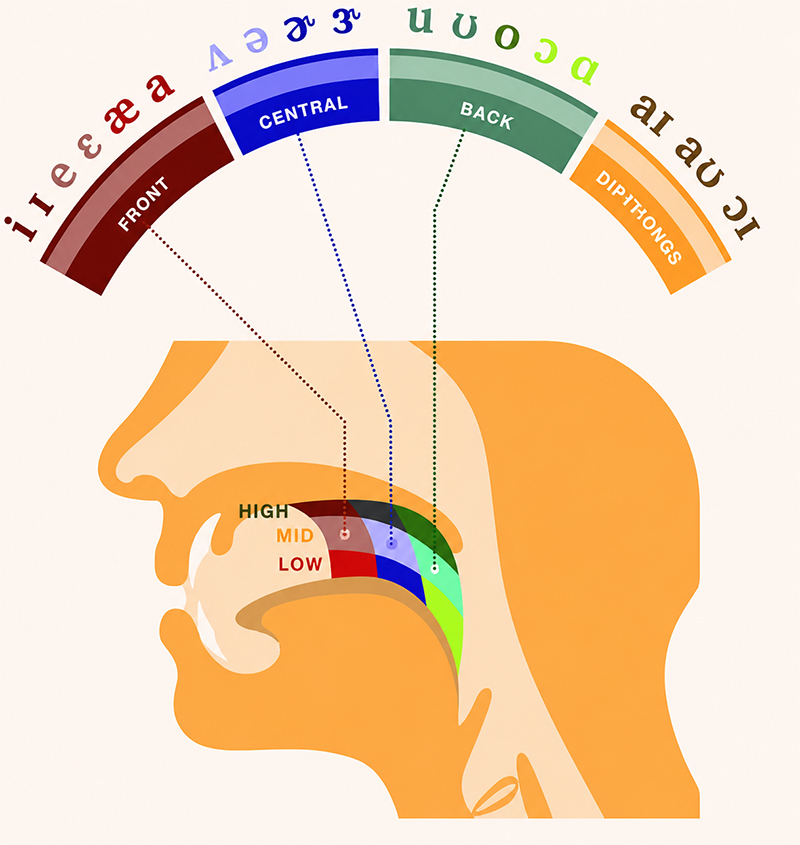
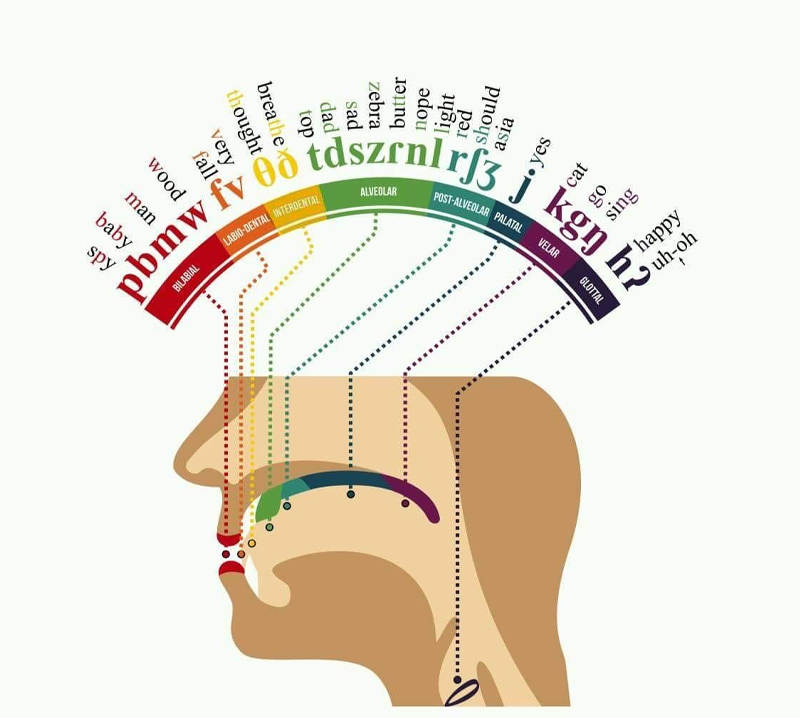
Research shows that infants explore the sound making capabilities of their vocal apparatus first and then use the interaction with adult speakers to guide them to the conventional sounds of their language (Howard and Messum, 2014). For example, take this example from a mother and child speaking together:
(1) Child (2 years, 2 months): il a des neus le camion (= the truck has tyres)
Mother: oui, il a des pneus, pneus [offers conventional pronunciation of noun]
Child: pneus [child responds with uptake of adult pronunciation]
By contrasting their own speech to the that of adults – often in the previous conversational turn – children make readjustments, fine-tuning their language to be more conventional and reinforcing a stronger memory trace of the correct form (Clark, 2020). Over time, children home in on the sounds adults use by repeatedly comparing what they wanted to say with what they actually said and what others say.
Just like acquiring any other skill, learning language requires a lot of practise. Listen to how the son of researcher Deb Roy homed in on the pronunciation of ‘water’ over six months.
Video 2 Birth of a word