If you are creating a new learner account between 8am on Saturday 6 June - 8am on Monday 8 June, you might experience delays or difficulties in the process. This is due to an upgrade to a system related to new account creation. We apologise for the inconvenience.
Start this free course now. Just create an account and sign in. Enrol and complete the course for a free statement of participation or digital badge if available.
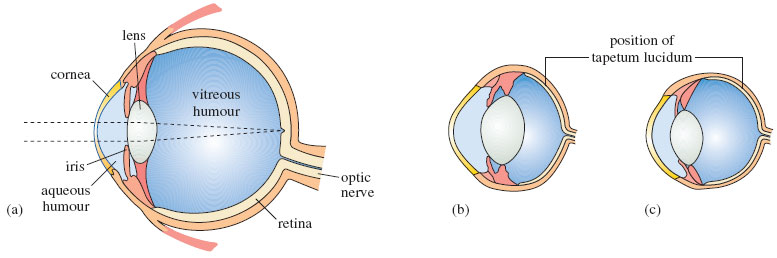
Figure 6: (a) Structure of the human eye, as revealed in vertical section. The path of parallel light rays from a distant object is shown, bent by the cornea and (mostly) by the lens and focused on the retina. Also shown are similar sections through the eye of (b) the lynx, which is nocturnal, and (c) the puma, which can hunt day and night. The position of the tapetum lucidum is indicated in (b) and (c) - in reality, this layer is far too thin to be discernible at this magnification