

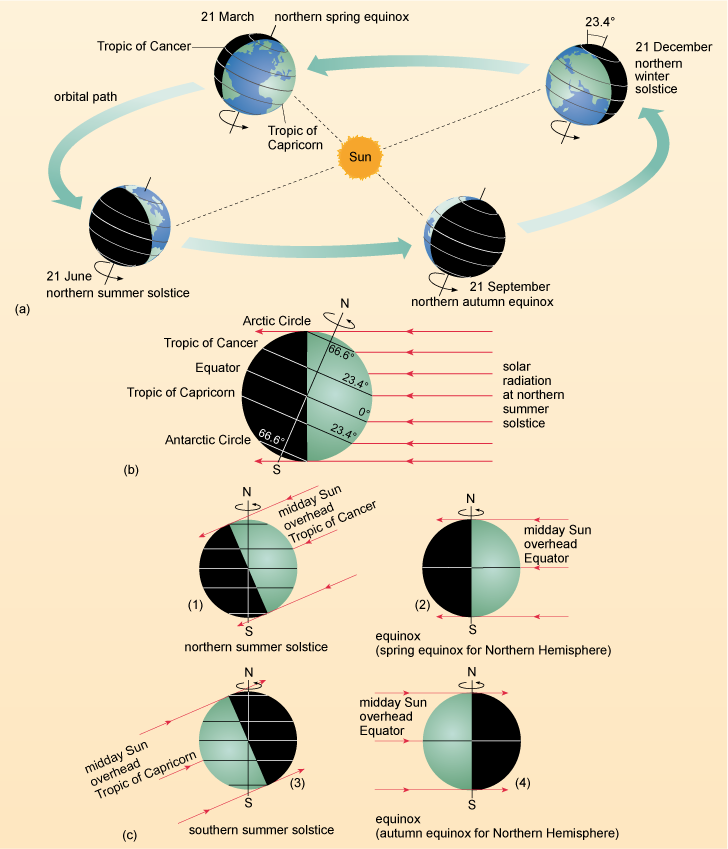
Figure 11 (a) The four seasons of the Northern Hemisphere in relation to the Earth’s orbit around the Sun. The Earth’s axis is tilted at approximately 23.4° to a line at right angles to the plane of its orbit around the Sun. (b) The angle of tilt of the Earth’s axis (at present 23.4°) determines the latitude of the tropics (where the Sun is overhead at one of the solstices) and of the Arctic and Antarctic Circles (66.6°, which is 90° minus 23.4°). (c) The passage of the seasons shown in terms of the position of the midday Sun in relation to the Earth: (1) the midday Sun overhead at the Tropic of Cancer, i.e. the northern summer solstice (cf. b); (3) the midday Sun overhead at the Tropic of Capricorn, i.e. the southern summer solstice; (2) and (4) at the equinoxes, by contrast, the Sun is overhead at the Equator, and the Northern and Southern Hemispheres are illuminated equally; days and nights are the same duration at all latitudes except at the poles, which are grazed by the Sun’s rays for 24 hours.