

2 Meadows and climate change mitigation: soil carbon
Meadows are able to store large amounts of carbon in their soils, which would otherwise be released to the atmosphere. Much of the CO2 plants convert into sugar by photosynthesis is used to feed fungi living on their roots, which in turn store it deep in the soil (a process called sequestration). One of the ecosystem services that floodplain meadows provide is carbon sequestration. Here it is protected from being released back into the atmosphere.
| Habitat | Carbon storage: Soil carbon in tonnes per hectare |
| Arable and horticulture | 47.3 |
| Intensively managed grassland | 67.2 |
| Neutral grassland | 68.7 |
| Broadleaved, mixed and yew woodland | 73.0 |
| Species-rich floodplain meadow | 109.2 |
Footnotes
Footnotes 1 0–15 cm data from Chamberlain et al. (2010).Footnotes
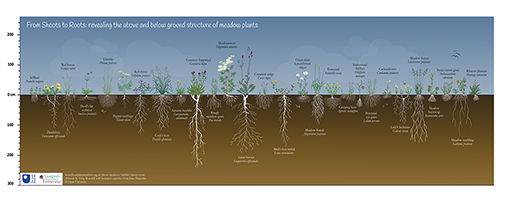
Footnotes 2 0–10 cm data from Lawson et al. (2018).Floodplain meadows sequester more carbon than an intensively managed grassland with only one or two plant species, due to their high diversity. The associated root diversity (see Figure 2) means more of the soil volume is used, allowing higher storage of carbon.
Additionally, floodplain meadows require no artificial fertilisers for the food they provide, which reduces their carbon footprint. You can find out more about this in the session on food security.
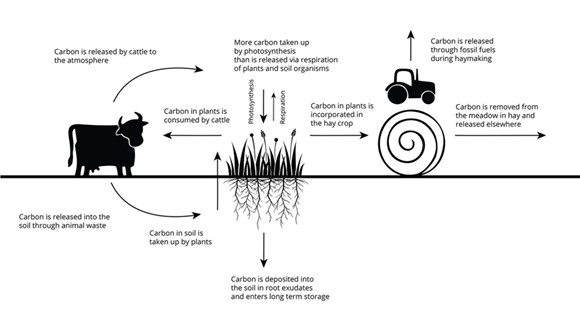
Figure 3 shows how carbon is cycled in a floodplain meadow.
Activity 1
Using just three of the species shown in Figure 2, select a meadow ecosystem that you think would do well for carbon storage. Comment on why you selected the particular species combination.
Discussion
Here is an example answer:
I selected these three species: great burnet, meadowsweet and birdsfoot trefoil.
I selected them for the diversity of their root systems, covering the ranges from less than 20 cm to more than 2 metre and 40 cm. This hopefully means the soil space is used more efficiently. Moreover there is also a variation of the species shoots, which will also enable higher above ground biomass storage.