
1 ‘Policing by consent’
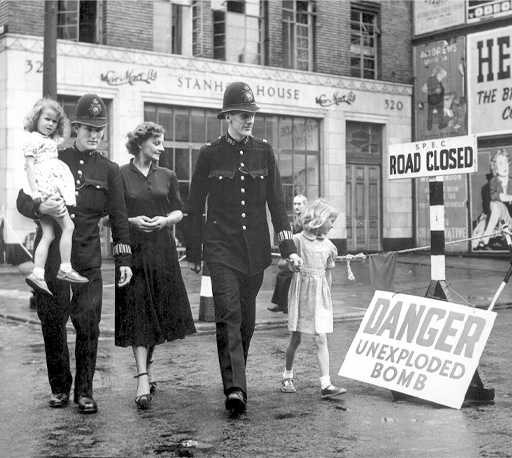
Figure 2: Police assist a mother and two children at a bomb site during the Second World War. [Description: A black and white photograph showing two police constables escorting a mother and two girls across a street with signs reading: ‘Road closed’ and ‘Danger unexploded bomb’. The mother is smartly dressed and walks in between the two officers. One officer is carrying one of the little girls, the other holds the hand of the other little girl. There is an office building in the background and also billboards on the side of an adjacent building.] Source: https://www.gettyimages.co.uk/detail/news-photo/during-the-blitz-police-officers-and-area-citizens-walk-by-news-photo/140973611?adppopup=true
‘Policing by consent’ is often cited as a defining characteristic of policing in Britain. Broadly speaking, it reflects an assumption that, rather than relying on the power of the state, or the use of force, policing in Britain is undertaken with the broad consent of the public. ‘Policing by consent’ recognises that:
… the power of the police to fulfil their functions and duties is dependent on public approval of their existence, actions and behaviour and on their ability to secure and maintain public respect.
The distinct nature of the office of constable, held by all sworn members of the police in England and Wales, is seen to have deep historical roots. Police bodies themselves often claim that:
… when Sir Robert Peel was designing the foundations of our police service, he put at its heart the citizen in uniform, policing by consent with absolute impartiality under the law.
Sir Robert Peel was the Home Secretary who introduced the Metropolitan Police in 1829. ‘Peel’s principles’ are frequently mentioned in discussions of ‘policing by consent’ and are seen as translating, for a modern world, long traditions of citizen policing in Britain, in direct contrast to the armed, centralised gendarmeries being set up in continental Europe in the same period.
In this week, you will investigate the historical validity (or otherwise) of a British tradition of ‘policing by consent’. But this issue is of more than just historical interest. Modern policing relies heavily on the maintenance of trust and confidence in the police. Without this, the job of policing is immeasurably harder. This is because:
… the degree of public trust in a country’s police service will have an impact on the level of resources required for the maintenance of public order and their ability to prevent crime and detect offenders.
Without public trust and confidence, ‘policing by consent’ becomes eroded and policing has to rely more on statutory authority and the use of force. As you will see in the next section, there are concerning signs in recent years of a significant diminution of trust in the police.