
3 Policing before the ‘New Police’
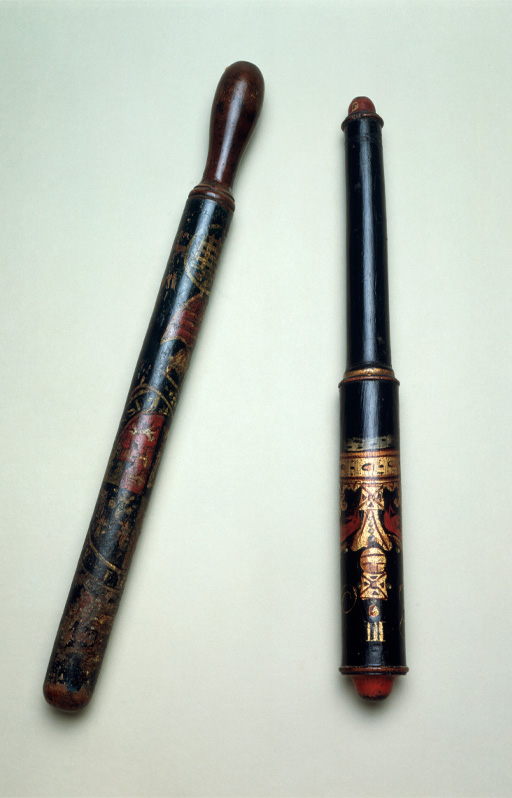
Figure 4: Truncheons carried by parish constables as a symbol of their office, 18th century [Description: A photograph of two parish constable truncheons. Made of wood, they are decorated with crests and insignia in gold, red and black paint.] Source: https://www.gettyimages.co.uk/detail/news-photo/truncheons-carried-by-parish-constables-18th-century-news-photo/464501451?adppopup=true
Before about 1750, policing in Britain consisted of three main elements:
- amateur parish constables
- semi-professional ‘acting constables’
- urban ‘watch’ forces.
Parish constables were traditionally unpaid local householders, picked every year to serve. They had a responsibility to assist in enforcing the law, via powers of arrest and entry, in relation to felony offences. They also undertook a range of other tasks related to the running of the parish (Britain’s smallest administrative district). These duties were all combined with their usual day job.
Increasingly, the job of constable might be undertaken year after year by the same man HP: should we add a caveat here to see that traditionally it was always a man? Although maybe that’s set up in Week 1?, particularly in towns where the population was such that there was too much policing business to be undertaken alongside a day job. In these circumstances, the office holder could, in effect, become a full-time policeman, gaining both income and experience in the process. There was often some suspicion of the motives of these ‘acting constables’, who were seen sometimes to be ‘in it for the money’ (as they were paid primarily via rewards for undertaking policing tasks).
Aside from these roles, many urban areas paid for a night watch to patrol the streets of a given area to deter criminals. This had traditionally been another role undertaken local residents but by the eighteenth century it was more commonly financed by a tax on wealthier inhabitants. The watch had limited powers of arrest and were not well paid, which made it difficult to attract able-bodied and effective men.
Activity 1 Opinions on pre-modern policing
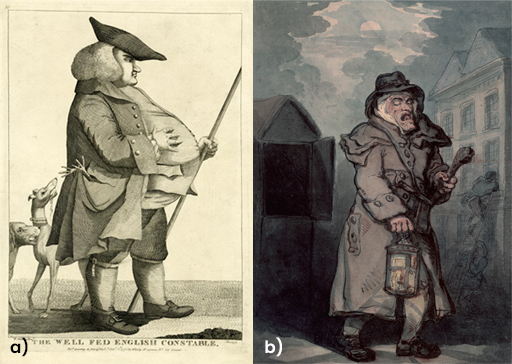
[Descriptions: Two images: The first is an engraving of a very overweight man in 18th century dress – britches, buckle shoes, waistcoat, coat and bicorn hat. The print is entitled ‘The well fed English constable’. He clasps his belly and carries a stave. Two growling and salivating dogs follow him. The feet of a chicken protrude from his coat pocket. The second image is a pen and wash drawing of an old man in long coat, hat and carrying a lantern and a cosh standing in an urban street in front of a watch post. It is dark and he is yawning. He fails to notice that behind him, in the background, a ladder has been propped against a building and two burglars are climbing into a first-floor window.] Source: https://www.britishmuseum.org/collection/object/P_1865-0610-1103 Source: https://www.gettyimages.co.uk/detail/news-photo/night-watchman-a-scruffy-looking-man-yawns-as-he-patrols-news-photo/464501447?adppopup=true
In the images above you can see two depictions of law enforcement officers. The first is entitled ‘The Well Fed English Constable’ and the second simply ‘Night Watchman’. Both date from the c.1770s. Examine the pictures carefully, looking closely at all the details.
What type of impression of policing do you think the artists were trying to convey? Make some notes in the text box below.
Discussion
During the latter half of the eighteenth century, many wealthy individuals were concerned at the prevalence of crime and disorder (as they saw it). By implication, they were dissatisfied also with existing mechanisms of law and order. The first image depicts a very overweight constable who looks rather ill-suited to the duties of pursuing and arresting criminals. The artist is probably implying that the constable has been enjoying the revenue generated by the position and has grown fat on it. The chicken feet protruding from his pocket perhaps hint he is not averse to the occasional bribe. In the second picture, the night watchman seems elderly and again ill-suited to his role. He is yawning in the middle of the night, oblivious to two burglars breaking into a first-floor window behind him. Both portrayals indicate dissatisfaction with current police arrangements.
Policing before 1750 was not a static system, however, and it changed rapidly from this point onwards. In London and other cities, elites were becoming concerned at a perceived crime wave in the early 1750s. Henry Fielding, an important London magistrate, created the Bow Street Runners – a group of constables and ex-constables paid a retainer to locate and arrest serious offenders, receiving government rewards on conviction. Over time, this force became more respectable and well-known to the public. (If you are interested in pre-modern policing in London, a useful summary can be found on the London Lives website [Tip: hold Ctrl and click a link to open it in a new tab. (Hide tip)] moved from footnote.) By the end of the eighteenth century, many towns and cities did have relatively competent and professional police forces.
Elements of the system of policing before 1829 could, therefore, be seen to embody ‘policing by consent’. Unpaid local residents taking turns to act as constables, and a watch force paid for collectively by local residents, support this view.
But a counter argument can be made – that policing was primarily undertaken for the benefit of the propertied classes. Evidence in support of this view includes the following:
- Responsibility for selecting and paying for the police rested solely with the wealthy.
- The watch was primarily directed to prevent property crimes.
- Parish constables were frequently directed by Justices of the Peace to clear the streets of vagrants, ‘disorderly persons’ gamblers and other (usually lower class) ‘undesirables’.
This was hardly ‘policing by consent’. Against this background, the police forces we know it today were developed. You will find out more about this in the sections which follow.