
5 The introduction to the Metropolitan Police (1829)
If the Metropolitan Police (and the forces subsequently set up following the same model) were not shaped by a foundational set of principles, why were they introduced?
In the later eighteenth century, many in the upper classes feared that the working class was becoming increasingly unruly and politicised. Some believed in a military-inspired solution. In 1820 the Duke of Wellington, an influential member of the Tory party concerned about radical demonstrations, urged that the government:
… ought, without the loss of a moment’s time, to adopt measures to form either a police in London or a military corps [...] or both.
Peel himself, as Chief Secretary for Ireland, had established a paramilitary Peace Preservation Force there in 1814, commenting that he had been ‘inclined to the establishment of a Body of Gendarmerie’ but that it needed ‘to be called under some less startling name’ (Emsley, 2021, p. 98).
Those formulating the Metropolitan Police were thus in part motivated by a desire to maintain order in a rapidly growing metropolis. But there was strong suspicion on the part of the public that a new police force for London would be akin to continental style ‘spy’ police. Hence, Peel was at pains in his public pronouncements to differentiate his policing proposals from European gendarmeries. Peel’s police were to be:
- uniformed, but in blue rather than red (as red was the colour of the army’s uniform)
- not routinely armed
- preventive rather than detective (with no detective function at all until 1842)
- distanced from direct control by politicians.
But while ostensibly working for all, it is also clear that the duties of the New Police were often directed more at certain parts of the population than others.
Activity 3 Resistance to the New Police
Consider the two pieces of historical evidence below. The first is an excerpt from the general instructions to new police constables in the Metropolitan Police. The second is a handbill indicating opposition to the new force. As you examine them, consider the following question:
What might these historical sources indicate about how ‘consensual’ the introduction of the Metropolitan Police was?
Source 1: Extract from ‘New Police Instructions’, The Times, 25 September 1829
The text reads as follows:
So it is lawful for any man belonging to the said police force, during the time of his being on duty, to apprehend all loose, idle, and disorderly persons, whom he shall find disturbing the public peace, or whom he shall have just reason to suspect of any evil designs, and all persons whom he shall find between sunset and the hour of eight o’clock in the fore-noon, lying in any highway, yard, or other place, or loitering therein, and not giving a satisfactory account of themselves, and to deliver any person so apprehended into the custody of the constable appointed under this act who shall be in attendance at the nearest watchhouse, in order that such person may be secured until he can be brought before a justice of the peace, to be dealt with according to law, or may give bail for his appearance before a justice of the peace, if the constable shall deem it prudent to take bail.
Source 2: Anti-police Handbill, 1830. The National Archives, HO 44/21, f.326
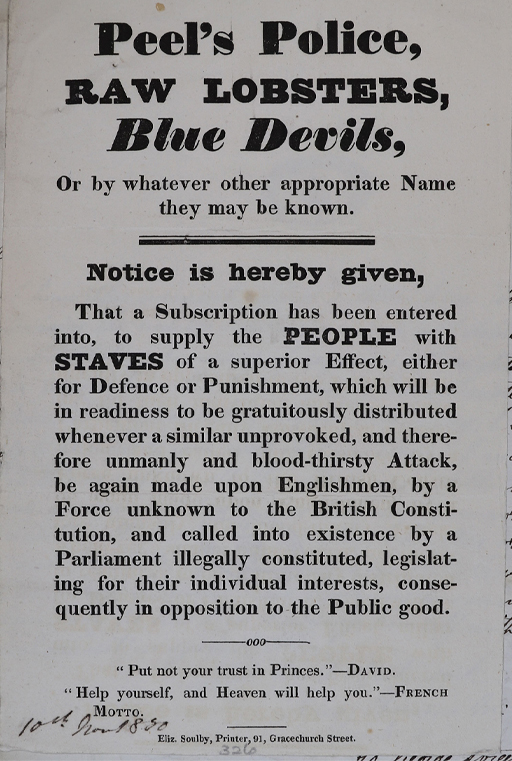
Source 2: Anti-police Handbill, 1830. The National Archives, HO 44/21, f.326
The text reads as follows:
Peel’s Police, Raw Lobsters, Blue Devils
Or by whatever other appropriate Name they may be known.
Notice is hereby given, That a Subscription has been entered into, to supply the PEOPLE with STAVES of a superior Effect, either for Defence or Punishment, which will be in readiness to be gratuitously distributed whenever a similar unprovoked, and therefore unmanly and blood-thirsty Attack, be again made upon Englishmen, by a Force unknown to the British Constitution, and called into existence by a Parliament illegally constituted, legislating for their individual interests, consequently in opposition to the Public good.
Discussion
Source 1 shows that constables were directed to control public space via the management of ‘loose, idle and disorderly persons’ and anyone who was ‘loitering around’ and ‘not giving a satisfactory account of themselves’. They had authority to do this under the Vagrancy Act of 1824, which gave wide discretionary powers. It is clear that powers like these were primarily directed at maintaining social control over the poorest members of society.
Source 2 indicates some considerable opposition to the New Police in London. Calling them ‘raw lobsters’ and ‘blue devils’ alludes to the colour change which lobsters undergo (from blue to red) when cooked, hinting that, despite appearing blue, the new police were in fact red (the colour of the army). Whether or not there was really a subscription taken to arm members of the public against the new police, the handbill is clearly evidence that not all inhabitants of London (including wealthy ones with the funds to print handbills) felt the new force was a positive development.
So, the Metropolitan Police were not inspired by Peel’s Principles (which were a retrospective invention of the mid-twentieth century). The new force also inspired considerable resistance at times. Some of this was grumbling about cost and levels of police cover but some was more fundamental resistance to the whole notion of a professionalised and centrally directed police for the city. Clearly the age of modern ‘policing by consent’ had a less than smooth start. But, in subsequent decades, the model of the Metropolitan Police was rolled out nationwide. What motivated this further expansion, and how was it received?