
6 The expansion of policing, 1839–c.1880
It took some time for new police forces to be set up outside of London. Around a third of counties, for example, had not set up police forces by the mid-1850s. At this point, the County and Borough Police Act (1856) made the establishment of police forces a requirement at local government level. An additional enticement was part-funding from central government if an annual inspection was successfully passed.
By about 1870 all but a handful of jurisdictions had set up new police forces following the model established by the Metropolitan Police. (This information pertains primarily to England and Wales. In Scotland, which had its own legal system, the English model was influential and new forces were established in roughly the same time period. In Ireland, which had the same legal framework as England during the nineteenth century, reform came with the Irish Constabulary Act (1822) and the Police Reform Act (1836) but policing was more focused on the use of force to resolve public order issues raised by Ireland’s relationship with mainland Britain. added from footnote) To what extent, however, did these new forces have the trust and consent of the public?
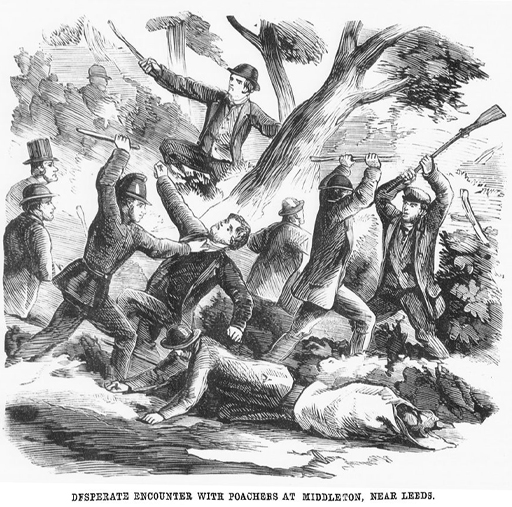
Figure 5 Image detail from the front cover of the Illustrated Police News, 10 August 1867, entitled ‘Desperate Encounter with Poachers at Middleton, near Leeds’ [Description: A black and white engraving depicting a fight between a group of uniformed police officers with truncheons raised and poachers yielding sticks. The fight is taking place amongst trees and bushes. One police officer has been knocked to the ground and there is a sack lying in the foreground – presumably containing the poachers’ quarry] Source: https://go-gale-com.libezproxy.open.ac.uk/ps/navigateToIssue?volume=&loadFormat=page&issueNumber=182&userGroupName=tou&inPS=true&mCode=1ZTS&prodId=BNCN&issueDate=118670810
Some historians have argued that the New Police were very unpopular. Friedrich Engels observed in the 1840s that ‘every week in Manchester policemen are beaten’ and certainly attacks on police officers were commonplace. Many of the duties of the New Police involved enforcing legislation related to sports betting, drinking and rowdy entertainments – all activities enjoyed by the working classes. The New Police were therefore referred to as a ‘plague of blue locusts’ and violent clashes and anti-police riots were by no means rare (as seen in Figure 5 above).
Activity 4 Assaults on the police
One measure of the extent to which ‘policing by consent’ is embedded in Britain is the level of assaults on the police. If the legitimacy of the police with the public is low, then resistance to the police will be high (and vice versa). Consider the statistics below, which show assaults against the police (per 1,000 of population) in the later nineteenth (1863) and in recent years.
What do you notice if you compare assaults against the police from the later nineteenth century with today?
| Year | Police Force Area | |
| London | Bradford + Leeds (1863)/West Yorkshire (2021/22) | |
| 1863 | 1.144 | 1.105 |
| 2021/22 | 0.315 | 0.18 |
Discussion
While any direct comparison between historical and contemporary statistics should be made with caution (see note above), it appears that assaults on the police by members of the public were very significantly higher in the nineteenth century than they are today. This could, perhaps, be taken to mean that ‘policing by consent’ is more in evidence today than it was then.
Other historians have made a counter argument, pointing out that the ability of the New Police to enforce unpopular laws were very limited. As David Taylor has noted:
Selective enforcement of the law was central to police success. Rigid enforcement [...] would have alienated the communities whose support, however qualified, was essential to the success of the police.
Most historians now recognise that the New Police were part of an effort to impose new standards of decorum and order on the working classes, but that they rapidly saw the practical necessity of treading a middle path between the demands of local authorities and the need for good relations with the communities in which they worked.
Thus, we might argue that ‘policing by consent’ was starting to develop but it was a long and contested process, as you will see in the following section.