
7 The transition to a ‘policed’ society, c.1880–1945
The period 1880–1939 was one in which crimes of violence declined significantly. British society became more orderly and, up until 1920, recorded rates of crime remained low. The later decades of the nineteenth century and the early decades of the twentieth were also a period in which police forces became accepted within British society to a greater degree than ever before.
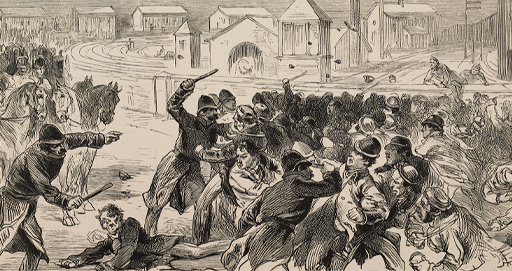
Figure 6 Police at an outbreak of disorder during a railway strike in Motherwell, Scotland (1891) [Description: A black and white engraving showing a clash between uniformed police officers with truncheons raised and a large group of male strikers. Several men have been struck to the ground. The incident is taking place on a bridge and the railway lines, train depot and other industrial buildings and warehouses can be seen in the background. Behind the police a group of mounted troops wait.] Source: https://www.gettyimages.co.uk/detail/news-photo/police-and-military-at-the-railway-bridge-motherwell-the-news-photo/1056698486?adppopup=true
There were still frictions between the police and some sections of the public during this period.
- Political demonstrations, strikes and industrial disputes still generated significant conflict. In 1886, following demonstrations in Trafalgar Square against unemployment and an economic downturn, rioting was so severe that the police lost control of central London for several days.
- The policing of working-class communities also often involved considerable use of force, even well into the twentieth century. As Arthur Pickering, an officer who joined a city force in 1932, described it, ‘in them days I was rough and ready […] if we hadn’t got no audience we could settle it around the corner. That’s how I tried to do most of my work’.
- The First World War (1914–1918) resulted in food shortages which provoked unrest and disorder, as well as a black market, the policing of which sometimes generated resentment.
None of the above frictions, however, were a threat to general acceptance of, and confidence in, the British police. Broadly speaking, the end of the nineteenth century and the start of the twentieth were marked by a growing sense of trust in the police, and even pride in many quarters. In 1906 the Times newspaper described the English police as:
… a great human mechanism, perhaps the greatest of its kind’ and a ‘credit to the men who are responsible for it, and a source of pride to every Englishman.
While not without frictions with some parts of the public, by the end of the Second World War, police/public relations were better than they had ever been.