
8 A ‘Golden Age’ for policing?
The period after the Second World War until the end of the 1960s has often been seen as the high point of ‘policing by consent’. As the historian Barbara Weinberger puts it, this was:
… a golden period when police and public were generally in accord that the English police were ‘the best in the world’.
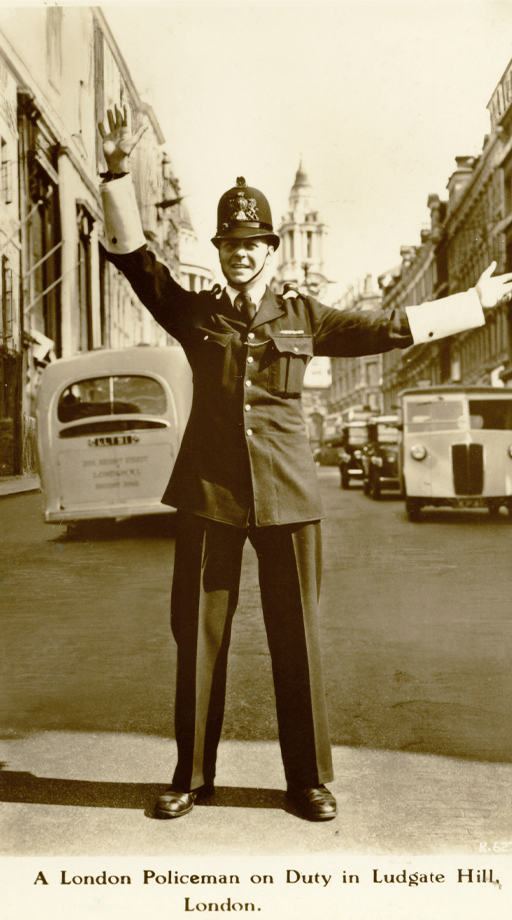
Figure 7: A postcard depicting a London policeman directing traffic, c.1950. The text on the back of the card reads “Always of a special interest to the visitors from abroad whose universal comment is “Your Policemen are wonderful” [Description: A postcard of a black and white photograph showing a uniformed police officer on traffic duty in the centre of London. He is smiling and has his arms raised in a signal and is wearing white traffic gloves and cuffs. Behind him on the road are period cars, vans and buses of the 1950s. St Pauls Cathedral can just be seen in the background. The caption below the image reads: ‘A London policeman on duty in Ludgate Hill, London’.] Source: https://www.gettyimages.co.uk/detail/news-photo/london-policeman-1950s-shows-a-policeman-directing-traffic-news-photo/1439193403?adppopup=true
The Second World War had bought an increase in crime (particularly theft) and new challenges for understaffed forces. But, arguably, the experience of war had brought the public closer to the police. As Inspector Hay commented afterwards:
… after the war, the relationship between the police and the public could never have been better. You were very good indeed with them. They thought the world of you, they came a little bit closer to you.
The post-war period had lower levels of violence and disorder than at any other time historically, and low levels of crime generally too. People were keen to put the experience of war and turmoil behind them.
Activity 5 Public confidence in the police
As part of the Royal Commission on the Police (1960–62) a public opinion survey was commissioned. Part of its findings are reproduced below.
What do you infer from this data about the proportion of the public who have confidence and trust in the police?
Source: author held copy – resolution may/may not be sufficient. Original held at The National archive.
HP: we could rekey/recreate as a table in oXygen
| [All figures percentages of total respondents] | Did not believe it occurred | Could not say | Hardly ever | Fairly often | Very often | Could not say how often |
|---|---|---|---|---|---|---|
| Q11. Do you think there is any truth in the suggestion that the police sometimes take bribes or do you think it most unlikely that they would? | 46.9 | 10.7 | 32.7 | 5.1 | 1.2 | 3.4 |
| Q12. In the methods they use to get information from people do you think the police are always fair, or do you think they may occasionally use unfair methods like questioning people for hours or tricking them into giving information? | 39.7 | 25.6 | 19.8 | 9.3 | 1.8 | 3.8 |
| Q13. On some occasions it is necessary for the police to use force to make an arrest. Do you think that occasionally the police use too much force? | 69.6 | 12.6 | 11.4 | 4.4 | 1.0 | 1.0 |
| Q14. Do you think that the police are always fair and truthful in court or do you think they may occasionally twist the evidence so that they will win the case? | 41.3 | 26.7 | 20 | 7.9 | 1.9 | 2.2 |
Discussion
Broad confidence in the police is evident in this survey data. It is perhaps noteworthy that more than 10% of people think the police use unfair methods either fairly often or very often, and 5% of people think the police fairly or very often use too much force. Overall, though, the survey shows that most people were pretty happy with the police in Britain at this point.
The mid-twentieth century can thus be seen as a high point of ‘policing by consent’ but some police practices carried over from the pre-war period were increasingly seen as out of step with a changing society. The taking of perks (free drinks from publicans and restauranteurs while on duty, for example) is frequently mentioned in recorded interviews with police officers who served during the 1960s. The manufacturing or doctoring of evidence, or obtaining evidence by unsanctioned or violent methods, were also relatively common.
In addition, the 1960s saw a series of scandals, including the so-called Rhino Whip Affair (where members of Sheffield’s C.I.D. were sacked for extracting information by force). These foreshadowed a gradual deterioration in public trust in the police over subsequent decades. You will find out more about this in the following section.