
1 ‘Stop and search’ and police use of force
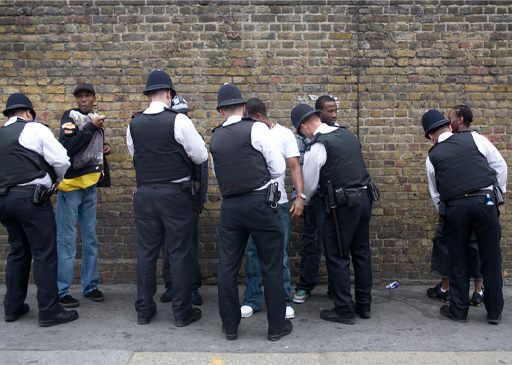
Figure 2: Police ‘Stop and Search’ procedures have been a focus of public debate [Description: Five uniformed police officers wearing stab vests search five young black men on the pavement with a brick wall in the background] Source: https://www.gettyimages.co.uk/detail/news-photo/police-stop-and-search-black-youths-at-the-entrance-to-the-news-photo/587482890?adppopup=true
The authority to stop and search individuals suspected of wrongdoing is an important police power. Over half a million people are stopped and searched every year and these powers are a useful tool in combatting crime and disorder. Police statistics, however, show disparities in the number of stop and searches carried out relative to the size of different population groups (Home Office, 2024a)). The figures for 2022–23 show that:
- 24.5 stop and searches were carried out for every 1,000 Black people compared with just 5.9 for every 1,000 white people
- Stop and search rates for Asian people and people with mixed ethnicity were also higher than those for white people.
Disparities by ethnicity have been declining in recent years but statistics like these lead some people to accuse the police of ‘over-policing’ – focusing undue attention on groups within the general population due to their ethnicity.
Those who are concerned about possible over-policing also point to the statistics on the police use of force against individuals they are taking into custody. Police officers often need to use restraint techniques and equipment (including handcuffs, a baton or irritant spray) when dealing with violent suspects or offenders. Police use of force statistics also indicate disparities by ethnicity. In the latest year for which data is available:
‘Use of force’ tactics involved people perceived as being Black at a rate 3.0 times higher than those perceived as being white (3.4 in the Metropolitan Police area).
Once arrested, Black men are more than twice as likely to die in police custody than white men, with some analyses claiming the figure could be as much as seven times more likely to die (Inquest, 2023). Past deaths of Black men in police custody (such as those of Sean Rigg in 2008 and Dalian Atkinson in 2016) have attracted significant adverse public and official scrutiny.
The issues discussed here – use of stop and search against young Black and Asian men, and disparities in use of force and death in custody by ethnicity – have led to a number of official reports into racism in British policing. You can learn about the findings of these reports in the next section.