
2 Official reports and public surveys
Reports and investigations by official and charitable bodies have also sometimes reached stark and uncomfortable conclusions about policing and race/ethnicity.
In 2023, a wide-ranging review of the culture and standards of the Metropolitan Police found that Black and Asian communities in London were both under-protected and over-policed, concluding bluntly that:
Racial disparity continues in stop and search in London [...] Enough evidence and analysis exists to confidently label stop and search as a racialised tool.
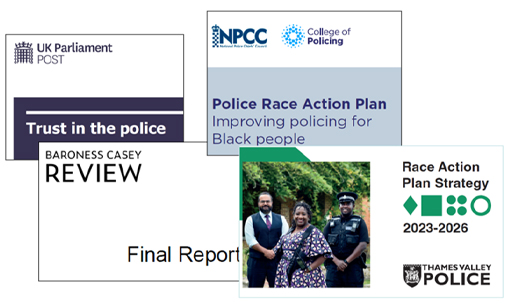
Figure 3: Official Reports into racism in policing [Description: A composite image of the front pages of four reports: UK Parliament, Trust in the police; NPCC, Police race action plan; Baroness Casey review, final report; Thames Valley Police, Race action plan strategy 2023-2026]
The Casey review also found evidence of racism against Black and Asian police officers from within the police and evidence of ‘institutional racism’ (p. 329). The term ‘institutional racism’ does not mean that all (or even most) police officers are racist. Rather, it implies that policies, procedures, and practices operate in ways which have disproportionate and disadvantageous outcomes for some parts of the community.
Reports focused on other areas of the country have reached similar conclusions. In 2022, for example, the National Police Chiefs’ Council (NPCC) (together with the College of Policing) developed a national Police Race Action Plan. Police leaders acknowledged that:
… policing still contains racism, discrimination and bias. We are ashamed of those truths [and] are determined to change them.
As of 2024, Police Scotland, Avon & Somerset Police and the British Transport Police have all accepted that the term ‘institutional racism’ applies to them. But the three biggest forces in England – the Metropolitan, West Midlands and Greater Manchester – have not.
Perhaps unsurprisingly given such controversy, policing is not a diverse profession. In 2022, self-describing Black, Asian, and ethnic minority individuals made up only 17% of all officers in the Metropolitan Police but 46% of the population of London. Similar disparities exist elsewhere, too.
Activity 1 Diversity and the police workforce
Figure 4: Police Workforce Diversity (in forces with over 10% diversity in force area) Source: Statistics compiled from Home Office, ‘Police workforce, England and Wales: 31 March 2022’ [https://www.gov.uk/government/statistics/police-workforce-england-and-wales-31-march-2022] Note – this figure may need to be reproduced by me if insufficiently high resolution, as I seem to have mislaid the underpinning data and chart.
Consider the data in Figure 4. The orange bars represent the percentage of the population in a given force area which is Black, Asian or minority ethnicity. The blue bars represent the percentage of the police force which shares those characteristics.
What does this tell you about the diversity (or lack of) in a number of big police forces?
Discussion
Figure 4 only includes police forces for geographical areas where over 10% of the population is Black, Asian or of mixed ethnicity. In an ideal world, the demographic makeup of a police force would match the demographic makeup of the population being policed quite closely. In actuality, all ten of the forces listed are considerably ‘whiter’ than the populations they police. Most of the ten forces have fewer than half the number of Black, Asian and mixed ethnicity officers which would be required for the force demographic to match that of the general population. For example, in Nottinghamshire, 15% of the population is Black, Asian or of minority ethnicity, but only 7% of police officers. Such under-recruitment from some communities is, as you will see, a longstanding problem within policing.
In 2023, academic research concluded that:
Nationally, while 42.6% of white British respondents said they trusted the police, only 32.1% of other people said they did.
Thus, a broad range of factors – including statistical data about policing, media reports, and official investigations – combine to make policing and race/ethnicity an area of public concern and scrutiny.
Police forces take this very seriously. A 2022 House of Commons Report concluded that ‘there have been important improvements in policing’ but also that there still remained ‘persistent, deep rooted and unjustified racial disparities in key areas’ (House of Commons Home Affairs Committee, 2021, p. 5). Part of the reason for this are the deep historical roots of the issue. You will now learn about this history and investigate its links with the present.