
3 A brief history of ethnic diversity in Britain pre-1945
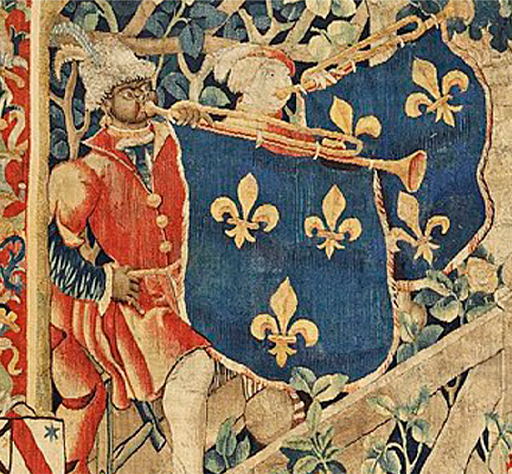
Figure 5: John Blanke, a trumpeter in the court of Henry VIII in 1511 [Description: A detail from a woven tapestry, depicting a Black man dressed in ornate ceremonial clothing from the 16th century, blowing a trumpet from which hangs a woven fleur-de-lis – a heraldic symbol forming part of Henry VIII’s coat of arms. Another, white, trumpeter is seen in the background] Source: https://en.wikipedia.org/wiki/Field_of_the_Cloth_of_Gold#/media/File:TapestryHenriFrancois.jpg
This week is primarily focused on the history of policing after the Second World War, but it is important to remember that Britain has a long history of immigration and ethnic diversity. Knowing something of this history is crucial as it provides the context within which policing has been operating.
While it is true that levels of immigration into Britain increased significantly after the Second World War:
… there have been black ‘communities’ of sorts in Britain since the 1500s.
Between the sixteenth and the nineteenth centuries, British society was overwhelmingly white, and there is strong historical evidence of significant and deep-rooted racism. That said, individuals from all around the world did come freely to live and work in Britain. Many of them thrived and made important and long-lasting contributions to British life. Thus, these centuries were marked by an unsettling combination of racism towards, and sometime acceptance of, individuals from other parts of the world.
Activity 2 Racism and acceptance
Spend 5 minutes looking at the simple timeline below and reading the descriptions of the tiles (you can click to enlarge it if you wish). Were you already familiar with any of these individuals and events? Did any of the information in the timeline surprise you?
Lower Tile 1 shows the hold diagram of slave ship operating out of Bristol in the 1740s, buying enslaved Africans and transporting them to the Caribbean. The extent to which many British individuals and organisations grew rich from their involvement in slavery is still being uncovered. Lower Tile 2: Even in the later nineteenth century, when enslavement had ended, highly racist attitudes are easy to find. This image shows a public exhibition which took place at Earls Court in 1899 called ‘Savage South Africa’, at which (mostly) white visitors could gawp at recreations of daily life in Africa. Lower Tile 3: This newspaper headline (from Cambria) details the race riots which broke out in Cardiff, Swansea and many other seaport towns 1919, with violence directed at Black and minority ethnic sailors. Upper Tile 1 shows Bill Richmond, a well-known British boxer of the early- nineteenth century, who bought and ran a pub near Leicester Square on his retirement. Upper Tile 2 contains photographs of an unknown, Black British policeman (mid-century) and the barrister Edward Nelson who worked on the high-profile Gorse Hall murder trial of 1909. Upper Tiles 3 and 4 bear witness to the huge contribution made by soldiers from the Caribbean and India (then part of the British empire) to the First and Second World Wars.
Discussion
The timeline gives just a few examples from a long history. It shows some adverse events (below the line) and more positive experiences (above). If you are interested in finding out more about the rich history of immigration and diversity in Britain, there are suggestions in the References section at the end of the course.
So, there were Black and Asian individuals and communities in Britain well before the Second World War but these numbered in the tens of thousands, rather than the hundreds of thousands or millions. This changed after 1948, with the arrival of the HMT Empire Windrush opening a new chapter in the development of a more diverse Britain. The next section will continue this story.