
5 Policing and the Windrush generation, 1950s–1970s
During the 1950s to the 1970s, the police were placed in a difficult position – navigating the effects of rapid social change in some towns and cities while successive governments did little to tackle integration, housing and economic deprivation. Often their actions were under media scrutiny during periods of social unrest such as the Notting Hill riots of 1958, when tensions between white working class and Black youths spiralled into days of sporadic violence.
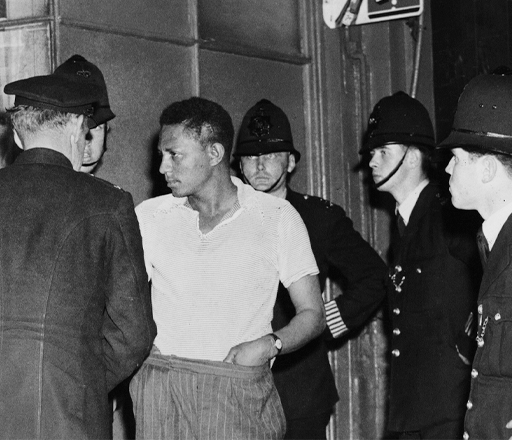
Figure 7: Notting Hill Riots, 1958 [Description: A black and white photograph showing a group of uniformed Metropolitan police officers surrounding and questioning a Black man in a white short-sleeved shirt. It is dark and they are standing outside a café called the ‘Pountite restaurant’ at No 257. The windows have been broken and the pavement is strewn with glass. Three other Black men stand in the café doorway watching.] Source: https://www.gettyimages.co.uk/detail/news-photo/policemen-questioning-people-outside-a-restaurant-during-news-photo/1212210475?adppopup=true
While the Metropolitan Police arrested twice as many white as Black youths, the riots led to tensions with the Black community owing to perceptions that police had not taken reports of racially motivated attacks seriously. Historians have unearthed strong evidence that during the post-war decades generally there was:
- Overt racism within many forces at all levels, as evidenced by comments in police reports such as those below (reproduced in Whitfield, 2004, p. 37).
- a.‘their [Black people’s] absorption into the community is slow and results from their below par mentality and their underlying suspicion of the white race’ (Tynemouth Police, 1953).
- b.‘they are generally insufficiently civilised to take their place in the community’ (Liverpool City Police, 1957)
- A reluctance to develop effective community liaison on the part of senior officers, with many preferring to deal solely or mainly with campaign groups led by white individuals.
- A resistance (at force level, but also within the Home Office) to diversifying policing and internal racism towards early recruits. There were no Black or Asian police officers at all until the later 1960s. Candidates applied but were uniformly rejected (often on spurious grounds).
- a.When surveyed on the possibility of admitting non-white officers in the early 1960s, one division of the Metropolitan Police replied ‘The truth is, of course, that we are not yet prepared to recruit any coloured men’ (AC ‘D’ Department, 1963).
These three factors – overt racism, reluctance to develop effective community liaison and an entirely white police workforce – shaped a police response to social change which saw the establishment of patterns of over- and under-policing of Black and Asian communities, and to some notable miscarriages of justice. You will explore these in turn in the next section.