
6 Early under-/over-policing and miscarriages of justice, 1950s–1970s
In London and the larger industrial cities, which had significant communities newly arrived from the Caribbean or the Indian sub-content, members of these communities were subject at times to either an undue amount of police scrutiny or, on many occasions, unwarranted or inappropriate practices.
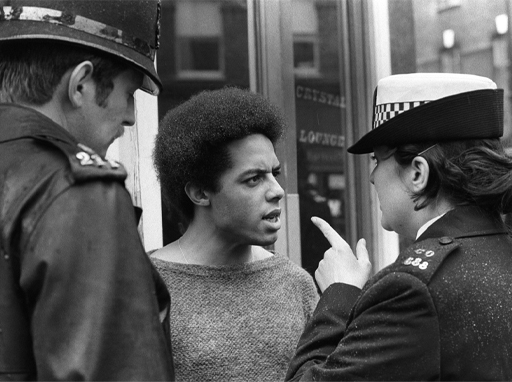
Figure 8: A young Black man is spoken to by police officers in London in 1977 [Description: A black and white photograph showing two Metropolitan Police officers in uniform, one male, one female, talking to a young black man outside a shop. The body language of the female officer is confrontational – she has a finger raised – and the young man looks back at her with a puzzled look on his face] Source: https://www.gettyimages.co.uk/detail/news-photo/police-officers-cautioning-a-young-black-man-in-sloane-news-photo/75040822?adppopup=true
Historians have uncovered evidence that police officers often believed Black and Asian individuals were responsible for a disproportionate amount of crime, despite the fact that their own statistics belied this. On occasion, over-policing was extremely blatant. As one retired Inspector, talking about the later 1960s recalled:,
… when you went out learning beats they would show you how to fit them [West Indians] up. One manifestation was the playing card. I’ve never talked about this before [...] Officers would play cards [...] if you produced the Ace of Spades you would have to go out and arrest a black pickpocket; and they would do so.
Alongside over-policing, there is evidence also of under-policing during the 1950s and 1960s – not following up on reports of racist abuse received by members of the Black community. As one historian of the police notes:
A strong case can unquestionably be made against [...] senior officers who never appreciated the potential goodwill that would have resulted had they taken action to deal with the divisive effects of racially motivated verbal and physical attacks on black immigrants, particularly in the 1950s.
Both under- and over-policing led on occasion to miscarriages of justice widely reported in the media, further souring of police/community relations.
Activity 4 The death of David Oluwale (1930–1969)
David Oluwale was a British-Nigerian citizen living in Leeds in the 1950s and 1960s. He was known to the police as homeless and drowned in the River Aire in 1969. While the death was not initially seen as suspicious, a police whistle blower revealed Oluwale had been victim to sustained and serious mistreatment by senior officers in Leeds police. His death resulted in the first successful prosecution of British police officers for involvement in the death of a Black person.
David Oluwale
Read the newspaper report on the trial of those involved in Oluwale’s death. What do you notice the report says about racism within the Leeds police force?
Newspaper page - will need to include the text for accessibility. Is there a version with clearer writing?
Discussion
You may have noticed that the newspaper article, and others like it, said nothing at all about racism within the police. It is clear from the police files that racism may well have been a factor (racist terms were scrawled on the relevant paperwork by the two officers concerned) but none of this was reported on in the trial. While the brutality and misconduct of these officers was addressed, the role of race was not made public.
Thus, by the early 1970s, issues of over- and under-policing, lack of diversity with the police and overt racism among some officers was already apparent. Because of these factors, the relationship between the police and the Black community (in particular) was to become much worse during the 1980s, as you will learn in the following section.