

5 Students’ views
In the next video clip, you’ll hear the views of three of Maggie’s students:
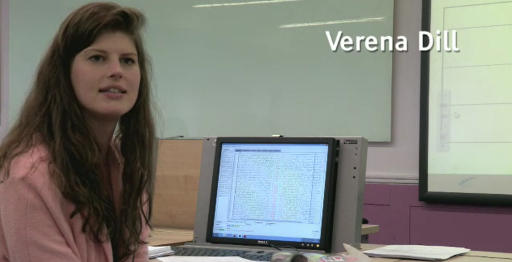
- Verena, a German speaker who is studying Economics
- Gabriele, who speaks both Italian and Portuguese as first languages and is a philosopher
- Li-Chia, whose first language is Mandarin Chinese and who is studying Archaeology.
Activity 3 Listening to three students’ views
Transcript
VERENA DILL
At the moment, I’m using corpora to analyse self-references. So, how to use them. For example, I use the word ‘we’ and looked at the hits. In my corpora, in my field, I have more than 2,000 hits, so it’s a word that is frequently used. And I now look at the combinations. So, what the authors do.
So, do they use ‘we’ in terms of showing results, or talking about what procedures they use? Something like this. This is what I’m doing at the moment.
MAGGIE CHARLES
I would be a millionaire if I had a pound for every student who has asked me ‘Can I use “I” in my thesis?’ Quite a lot of you are using it less frequently than the experts. And more frequently than the experts? OK, right.
English tends to be a language which certainly allows – and certainly for certain disciplines – the use of ‘I’ and ‘we’. And that may be very much something which is not allowed by the native languages of some of these students. So they will find it really very, very strange when they encounter it in reading research articles, for example.
VERENA DILL
My native language is German. So, in German, in scientific texts or at school, we learned not to use any self-references. So, for me, as a German native speaker, it’s kind of unusual to use this kind of self-reference. So for me, corpora is essentially giving me kind of a feeling how native speakers in English would use self-references.
GABRIELE CORNELLI
The fact is, we should need to understand how people – scholars in our field – they write in a good English way. And so this software and this management of the corpus of writing, is a good tool for us to have a quick and very effective search. I am an Italian and Portuguese speaker. And so when I try to write and speak – especially writing in English – I have to realise at the time that I think that I am writing in English, and sometimes I’m just translating from my own language.
MAGGIE CHARLES
What we’re trying to do is to show how some of the most frequent collocations can be linked to certain functions of discourse. So, for example, we look at – as we did today, we were looking at self-reference, and we were thinking not just about whether ‘we’ and ‘I’ were used, but actually the functions that they were carrying out within the texts and within the corpora.
LI-CHIA LIU
I find it quite useful, because my English writing ability is poor. And I now quite understand what specific terms and using which appear quite frequently in the successful essays written by very acclaimed researchers. So I can imitate their writing.
- As you listen, make notes on what each student says about the value in using a corpus.
- Why does Maggie think it’s difficult for EAL students to use first person pronouns in their writing?
Discussion
- The three students are all positive about using corpora to investigate academic writing in their subject areas. Verena is currently using her corpus of Economics articles to search for instances – or ‘hits’ - of the first person plural ‘we’. She shows us the different ways in which writers combine ‘we’ with other words in her English corpus and comments that in German it is unusual to use ‘I’ or ‘we’ in scientific writing. Gabriele describes corpus software as a good tool. He says he realises that he often translates from Italian or Portuguese into English, rather than writing directly into English. Finally, Li-Chia says she finds it useful to explore the writing of successful academics in order to learn from them.
- Maggie points out that English is a language that allows ‘I’ and ‘we’ in some disciplines whereas some students’ first languages may not allow this. The corpora may thus throw up surprising patterns for students.