

8 Changing the culture
Another fascinating project that Gill did involved Prostate Cancer UK – a charity dedicated to raising awareness for prostate cancer. She describes the issues that Linguistic Landscapes helped to address in a case study, ‘How language reveals barriers to success’, which appeared in the business magazine Market Leader.
Activity 8 Facilitating organisation culture change
In the case study, Gill focuses on how linguistic analysis can facilitate organisational culture change. Read the following excerpt from it below. As you read, think about what you’d expect the revamped website to look like.
Prostate Cancer UK: renovating a brand from within
In late 2011, the Prostate Cancer Charity was set in its ways and, although respected, was punching below its weight in terms of effectiveness. The charity knew it needed radical change and had appointed a new CEO and its first director of communications. It had ambitious targets for growth and a much higher public profile. In particular, it wanted to reach a more diverse range of men.
The board committed to a project led by Seamus O’Farrell, the charity’s director of marketing and communications, titled ‘We, the Brand’.
The brand was ostensibly the focus but many knew this also meant serious organisational and cultural change. Paul Feldwick was working with Seamus as brand and organisational consultant. He brought us into the team early in the brand redevelopment and we kicked off the process by examining forensically the language the charity used every day, both internally and externally.
We dissected documents, spoke to people as they worked, listened to helpline calls, lurked in meetings and peered at notices on walls. We put all this language through rigorous analysis, looking for patterns and clues. The charity is deeply committed to science, knowledge and evidence, and this systematic approach made sense to them.
When we had, as one of them put it, ‘fed us through the X-ray machine’, we shared the results initially with a large group – 50 or so people in one room, from all areas and levels, including the charity’s agencies and everyone helping with the rebranding process.
The charity’s language showed some subtle but persistent features. Here are just some of them. There was habitual indirectness and distancing in language, and a marked use of euphemism and hyper-politeness. The density of text – enormously long reports, minutes, even newsletters and information sheets – was striking. There was medical and NHS language where you would expect it, but also often where you would not.
While there were occasional bursts of outrage (at the plight of men with the disease) and fighting talk, especially by individuals in conversation, this was submerged. We characterised it as a ‘muffled’ discourse – soft, quiet, civilised and caring – but muffled. In fact, the office interior and brand identity (inasmuch as one existed) echoed this – nursing blue and white, rather bland and eerily calm.
From micro examination of verb forms, we could see the charity tended always to position itself as acting outwards, on other people or things, while not (at least linguistically) allowing the possibility of other parties acting on it from the outside. This observation, as for others, produced a ripple of recognition – it articulated a habit or attitude that felt familiar. Theirs was, they recognised, a ‘very British, middle-class, educated, expert and somewhat paternalistic’ discourse.
Let’s be clear: an organisation’s current culture, the one that’s holding it back, was once fully adapted to the strategic and market conditions of the time, and to the leadership that shaped it. It must have been, or the organisation wouldn’t have survived or been successful. Some elements may still be valuable. But the culture now contains attitudes, implied relationships and world views that are outgrown or outdated.
And this is what had happened to the Prostate Cancer Charity. Things that had helped it succeed in the past had outlived their usefulness but were now baked into the culture, perpetuated through habits of language and, because invisible, very hard for them to change.
(Ereaut, 2013)
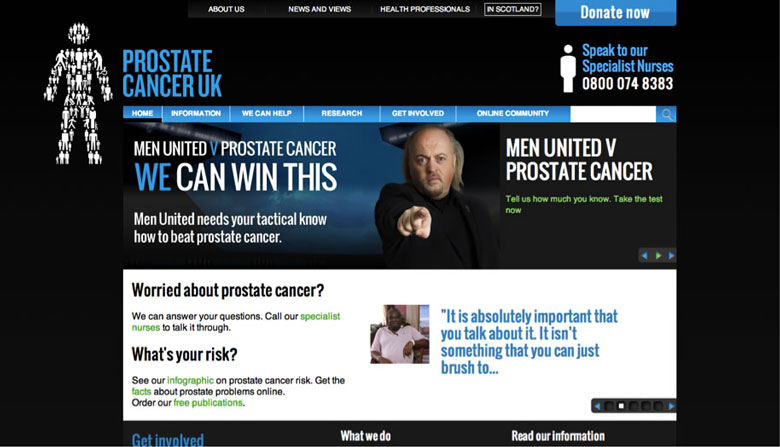
After you’ve read the excerpt, look at Figure 1 below, which is a screenshot of Prostate Cancer UK’s homepage. This is what the website looked like after Gill worked with the organisation (unfortunately, it is no longer possible to view what it looked like before).
- Can you see any evidence of the types of features that Gill describes as ‘very British, middle-class, educated, expert and somewhat paternalistic’: indirectness and distancing, use of euphemism and hyper-politeness, dense text, civilised and caring language?
- How is the audience of this website constructed in relation to the charity? Think about the use of material processes, use of imperatives (or commands) and who the language appears to be empowering.
Discussion
There seems to be almost no evidence of indirectness, euphemism and hyper-politeness, or dense text (high lexical density). The audience is directly addressed (both charity and audience being referred to by personal pronouns) and construed as a strong collaborator with real power (‘we can win this’, ‘your tactical know how’). The voice of the charity’s audience is even given space and is directly represented in the form of quotes with picture in the bottom right of the screen. The audience is represented as being involved in material processes (‘win’, ‘beat’). They are also invited to act by a number of imperatives or commands (‘donate’, ‘speak to’, ‘call’, ‘see’, ‘order’, ‘tell us’, ‘get involved’). While imperatives can construct the people they are directed at as subservient, given the context here (the urgency of ‘doing something’) and other language that constructs the audience as collaborators, they seem to be empowering and motivating. All of this is supported by the strong colours on the page and by the gaze and pointing finger of Bill Bailey in the centre, a British comedian known for being irreverent, quirky, intelligent and well read. Given the objectives of the charity, do you think that these changes will have the desired effect on the people they are aiming to reach (i.e. possible donors and men in general)?
As a result of Gill Ereaut’s work, Prostate Cancer UK gained visibility and is more successful as a charity. It even won the Third Sector Excellence Award in 2013 for this successful rebrand.
If you’d like to follow this up further, you could look at the current Prostate Cancer UK website [Tip: hold Ctrl and click a link to open it in a new tab. (Hide tip)] and consider what is the same and what has changed since 2011. At the time of writing in 2026, the website featured a Black man hugging a white man. The main headline was ‘It’s about time no man dies from prostate cancer’ and below this, text detailing how 1 in 8 men get prostate cancer but this is double for Black men. The use of the second person pronoun ‘you’ speaks directly to the reader .