
1 The scope of speech and language therapy
In this week, you’ll listen to an interview – divided into three segments – with senior speech and language therapist, Dr Sean Pert, and hear him talk about his approach to his work, including his experience of working with multilingual children (Pert, 2023). In the area of the north-west of England where Sean works, a large proportion of the local population, and consequently a large proportion of the children referred to him for support, are of Pakistani heritage and encounter at least two, and often three or four, spoken languages in their daily environment: typically, the unwritten ‘local dialect’ Mirpuri and the regional language Punjabi, as well as local and national varieties of English. When referring to the experience of children in such contexts, and in line with common practice among linguists, Sean uses the terms ‘bilingual’ and ‘bilingualism’ to embrace ‘multilingual’ and ‘multilingualism’. As with any other population of children, a small proportion of these children will experience language delays or disorders.
You’re now going to listen to the first part of an audio interview with speech and language therapist, Sean Pert.
Activity 1 The role of an SLT
As you listen to Sean, make notes on the following questions.
- How does Sean define the three aspects of an SLT’s work?
- What linguistic functions does Sean identify as being of particular importance at different stages of a child’s development?
Transcript
Sean Pert:
Hello, my name’s Sean Pert. I’m a speech and language therapist. Today I’m going to be talking about children with speech, language and communication needs. I’ve worked for about 19 years in the north-west of England with children with a whole range of speech, language and communication needs, including those who are bilingual and have difficulty learning to speak in their own languages.
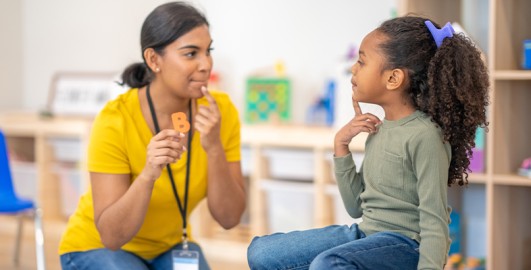
Speech and language therapists have in their title both ‘speech’ and ‘language’ and that’s because children have difficulties with either speech – that’s the physical production of sounds, and the mental representation of those sounds, so they might be able to physically say a sound but not have learnt when to use that sound yet – or with language – so that incorporates verbal comprehension and verbal expression. But we also have speech and language therapists who deal with, for example, children who aren’t able to use verbal communication and use computer technology to communicate.
So you might describe it as communication of any modality. When children need to express themselves, particularly the younger children that we see – so I would say children under five – they’re getting their basic messages across. And if you think about the stages of language development, children often talk about what they’re doing; so they’re almost thinking out loud: ‘Look mum, I’m riding a bike’, ‘I’ve got a new hat’ – things that they find exciting about the world around them.
For older children, they tend to start to question how things happen, how everyday events relate to themselves. So they tend to ask more questions: ‘Where does water come from?’, ‘Do birds have television sets?’ – you know, they have all sorts of flights of fantasy, and they start to learn about the real workings of the world. Teenagers start to think about much bigger issues and think about maybe political issues or moral issues.
So the language skills that relate to that are different at different points in the child’s life. So for young children basic sentence structure is really important. Children – seven, eight and nine – are having difficulties perhaps with making friends, with understanding the pragmatic rules and the language skills they need to do things like narrative; so, to talk about what they did at school that day, or if they went on a school trip, the sequence of events and how to explain that to others who weren’t there to see it.
Older teenagers, often labelled as having behavioural difficulties, can turn out to have language impairment, and they have much more subtle difficulties, such as understanding when somebody needs further information to understand their point of debate or to understand their perspective. So they need to understand things like theory of mind and understanding someone else’s perspective, using language to persuade, to question, to probe. So, in that sense, language skills need to mature.
Discussion
- Sean distinguishes between speech (the physical production of sounds) and language (the mental representation of those sounds, in other words the comprehension and expression of meaning). To these he adds ‘communication needs’ and relates this to other modalities, some of them technologically mediated, by children who lack the ability to produce speech. You may have noted that he refers to ‘children who aren’t able to use verbal communication and use computer technology to communicate’, meaning communication through spoken language. The broader meaning of verbal in linguistics covers spoken, written and also signed language and it should be noted that some computer technologies may actually rely on verbal means, such as written words or words sounded out electronically, whereas others may rely on a more direct relationship between action and image. In this instance, the children Sean is referring to in his response are clearly those who are unable to use oral communication.
- Sean explains that very young children tend predominantly to use descriptive commentary on actions in the here-and-now (‘almost thinking out loud’), using present tense descriptions in basic sentences. Slightly older children ask more questions and find themselves needing to give narrative accounts of events to people who were not present at the time. Teenagers begin to use language for more complex functions such as persuasion and more speculative language relating to moral choices, drawing inevitably on a wider range of processes. These evolving communicative purposes will apply regardless of which language is chosen by the child.