
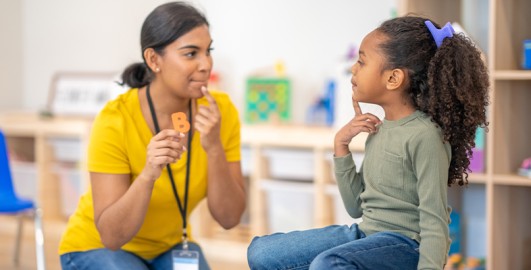
3 Speech and language therapy with bilingual children
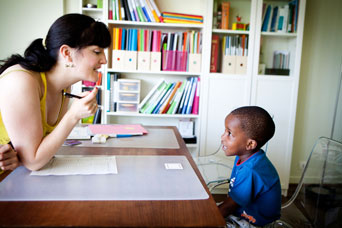
Activity 3 Assessing the meaning-making abilities of a bilingual child
Whether you are yourself monolingual (with English as your only language), bilingual (using two languages) or multilingual (two or more languages), pause for a moment and note down (ideally in discussion with others) what might be the particular challenges for a therapist or teacher in assessing the language abilities of a child with multiple languages. Would you expect the process to be fundamentally the same or different for a bilingual or multilingual child?
Discussion
You may have thought that what may be diagnosed as a delay in language acquisition may simply be a reflection of the additional learning load for the bilingual child, or of grammatical differences between the languages involved. Specifically, children who have been raised speaking a language other than English in the home may be misjudged by some educational or health professionals as having a language disorder if they get the English word order wrong, or don’t use basic word endings such as the -s for plural nouns or third person singular verbs (e.g. sits, bakes) that would be expected of the usual development of monolingual children. According to the conventions of their first language, bilingual children may also respond to questions or prompts differently, with a choice of yes or no that differs from the conventions of standard English. Alternatively they may have been brought up to regard silence as the appropriate response to an adult’s questioning, in other words they may have acquired different cultural behaviours in their first language community that are not a matter of language structures alone. This is not an exhaustive list, and you may well have identified other aspects of a bilingual child’s behaviour that could potentially mislead a professional into underestimating the child’s linguistic skills.
You may perhaps have also considered some of the additional skills that the bilingual child might possess which could be hidden by a conventional monolingual assessment.
Activity 4 What special linguistic skills do bilinguals develop?
Now listen to the third part of the interview with Sean Pert. What does Sean identify as the particular insights that bilingualism can bring? (Note that Sean refers at several points to Mirpuri, the Pakistani heritage language spoken by the children alongside English.)
Transcript
Sean Pert:
I work with bilingual children, mostly from a Pakistani heritage background. Children will hear codeswitching, very frequently from their parents, because they’re living in a bilingual world. So they will use English, for example, when they’re out shopping, and they will hear Mirpuri, their home language, when they’re talking to friends and relatives. And often the community have parents where one parent would speak Mirpuri, another would speak Punjabi, and all of them would speak English to some degree.
Many professionals, and indeed parents, believe that bilingualism is a disadvantage, particularly for education, because education tends to be delivered in the medium of English. Many parents say to me ‘Are you going to look at my child’s English skills?’, and I reply ‘No, I’m going to look at their strongest language, which is your home language.’ Parents are quite surprised that once children have a foundation home language, I don’t need to see them anymore because they naturally acquire English spontaneously using their own resources and the strategies and techniques that they’ve learnt via acquiring their home language.
It isn’t bilingualism itself which causes speech and language problems, they just happen to have difficulties in the same way as other monolingual English children do. Children who hear two languages in their community are very likely to do that themselves. So, for example, they would insert content words, particularly, into a grammatical frame, but the grammatical frame itself would maintain the integrity of the home language that was selected.
So, for example, in Mirpuri, which is a Pakistani heritage language, they have the agent, the patient and the action in that order. So, for example, ‘The girl is eating a banana’ would be ‘[SPEAKING MIRPURI]’, and that’s literally ‘The girl banana eating’. In codeswitching, children are just as likely to say ‘A girl banana eat [canipy]’, that way they’ve inserted the English lexical items of ‘girl’ and ‘banana’ and what the children do there is do a dummy doing verb, just doing, to hold the gender agreement and the morphology.
This is very sophisticated and this is something that children from around the age of three and a half are able to do, which, not coincidentally, is the same age that monolingual English children become able to use morphology confidently. So we can see that children who are able to insert English words into their home-language frame are sophisticated language users and therefore are not cause for concern. Interestingly, children with specific language impairment who are bilingual are unable to integrate two languages together; and children who don’t codeswitch in this way are therefore good candidates for further investigation to see if they are having difficulties with their language acquisition.
Actually, bilingual children have an advantage in that they can see that the surface pattern is exactly that. So an item like ‘banana’ they’ll hear it called ‘banana’ and ‘kela’, so they can see that it’s a surface lexical item that’s attached to a deeper meaning. So bilingual children have this unique perspective, they can see both sides of the linguistic labelling system. They're also exposed to two different syntax and grammar structures when they're hearing English and Mirpuri, so they very quickly become adept at acquiring languages.
It’s interesting that children who remain bilingual seem to have an advantage when it comes to acquiring additional languages and also in their metalinguistic skills in general.
Discussion
Sean notes that bilingual people are particularly skilled at separating form from function, in other words their access to two languages shows them that the same (or at least closely related) meaning can be expressed in lexically and grammatically different ways. Most bilingual people also have the additional skill of being able to codeswitch – or shift rapidly between languages – at grammatically appropriate points; indeed the failure to develop this skill might itself be seen as a disorder in normal bilingual development. Both these skills are frequently overlooked or undervalued by parents and teachers – a situation that Sean tries to address in his daily work.