
1.5 Is statistics mathematics?
Statistics is a mathematical science which is applied to day-to-day situations; it uses mathematical methods so there is overlap between mathematics and statistics, but they are different disciplines. Statistics can be used to analyse, interpret and explain situations using collected information (descriptive statistics) but this information can also be used to model situations and make predictions about what might happen in the future (inferential statistics).
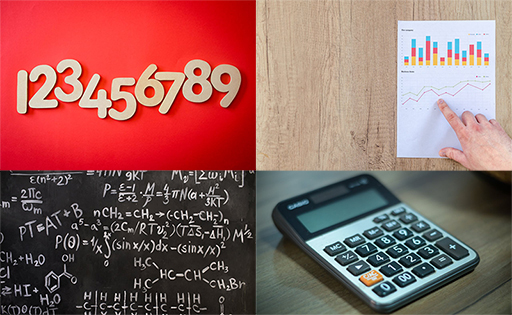
Statistics is often far ‘wordier’ than other areas of mathematics; it is as important to understand the language of statistics as it is to perform statistical calculations. Some answers in statistics can be subjective, based on the interpretation of the data by the person writing; however, by practising and discussing interpretation of data, it is possible to learn how to identify the key elements required to reach a conclusion. This course will help you with doing this. We are so accustomed to mathematics being ‘right or wrong’ that something seems amiss when we do not have a definitive answer in a mathematics lesson. Uncertainty and variability are two of the key concepts involved in statistics and, as a learner of statistics, you will need to become comfortable with these notions.
Uncertainty arises when we do not have complete information about something. This leads us to consider the chances that something might be true or the chances that something might happen, also known as the probability of an event. Probability theory is a significant part of the mathematics that underpins statistics but not one which will be addressed in this course. Here, you will be looking at the bigger picture of how statistical techniques and calculations can be used to make sense of the world around us by finding patterns in data that vary and include small, acceptable errors.
In the next section you will look at the data handling cycle and focus on the planning aspect of a statistical investigation.