3.2 Personal data
Since a play park is aimed at the younger population, it is probably more important to know more about their age than the age of the adult population. So, if the play park does go ahead, you can aim the equipment at the appropriate age groups who are likely to make use of it.
You probably do not want to be asking people for their exact age as this is quite personal information that they might not want to share. Collecting exact ages could also produce an unwieldy data set to manage as there may only be one or two people of each age across a wide selection of ages in the village.
This can be dealt with by using categories.
In what age category (in years) are you?
0–4, 5–10, 11–17, 18+
You need to be clear about how categories are defined at the outset, for instance, where would you place someone who is 4 years and 11 months old i.e. nearly 5?
It is important to ensure the age categories do not overlap and that every relevant age is covered; it is also good practice to include options for those who may not want to answer such as ‘prefer not to say’.
Data organised in this way is known as grouped data and certain graphs are better for presenting grouped data. Therefore, the way your data is collected and organised will impact how it is used and presented in the later stages of the investigation.
We need to collect and use data with responsibly and care, ensuring that we do not cause harm and that any personal data is kept securely.
What might be the issues with collecting information, particularly from children?
Children are likely to be less aware of the risks involved with sharing their data, so it is important that you, as the researcher, think about the need to protect their data from the outset. For younger children, it is likely to be the child’s parents/guardians sharing the required information with you and they may choose not to do so.
If you are asking questions to children, you need to consider their ability to understand what they are being asked and whether they can clearly express their answers to the questions.
These are just a few of the considerations that might be made when trying to find out something as simple as the age demographic of a small population. Hopefully, you can see just how many aspects there could be to consider in any statistical investigation.
Demography (noun)
The study of human populations, especially the study of statistics, such as numbers of births and deaths, the incidence of disease, or rates of migration, which illustrate the changing size or composition of populations over time. (OED, 2024)
Demographic (Adjective and noun)
Of or relating to demography or demographics; especially relating to the size, composition, or characteristics of a population and different groups within it. (OED, 2024)
Population typically refers to an entire group (usually of people or animals). When collecting data, surveying an entire population could be expensive/difficult and you may need to choose a sample. We discuss this later in Week 2.
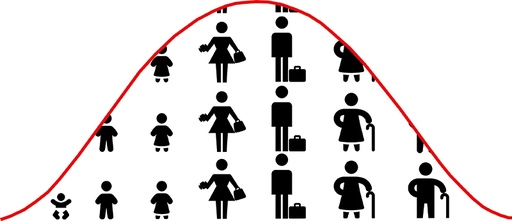
There is no need for groupings to be evenly spaced across the whole of the population. Many populations have a bulge in the middle of the data (more of the middle values) and the number of items tails off at each end, as with a normal distribution. Therefore, it is common in statistics to see larger group widths at the beginning and end of a data set and more refined, smaller group width in the middle of the data.