1.5 Systematic sampling
Creating a systematic sample means selecting repeatedly from a list of population items (a sampling frame) with regular gaps, for example taking every 8th item. The idea of a sampling frame was introduced in the ‘Taking a random sample’ video; in the classroom, a simple sampling frame might be the register. The value at which the repetition takes place is calculated as follows.
- Step 1: Divide the total number of items in the population by the number of items required in the sample; this gives you a number which you may need to truncate, call this t. (Truncating means to ignore any digits after the decimal point.)
- Step 2: Randomly select a starting value from 1 to t inclusive.
- Step 3: Select systematically every tth value after that.
Step 1: Divide the total number of items in the population by the number of items required in the sample; this gives you a number which you may need to truncate, call this t. (Truncating means to ignore any digits after the decimal point.)
Step 2: Randomly select a starting value from 1 to t inclusive.
Step 3: Select systematically every tth value after that.
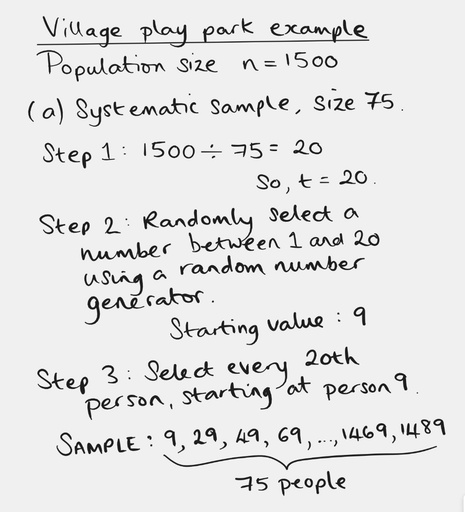
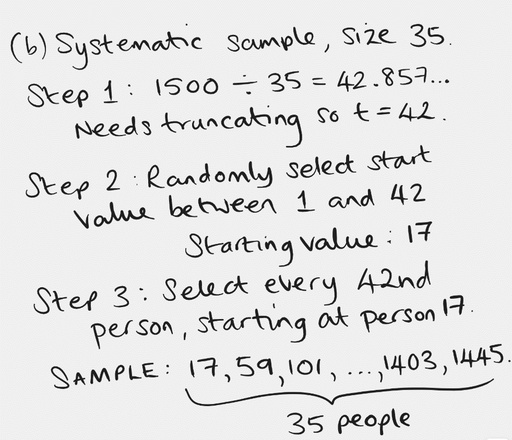
See Figure 6 below for how this method could be applied to the village population to obtain a systematic sample of (a) size 75 or of (b) size 35.