

1 Early learning centre
A child’s journey towards being a fluent language user begins before they are born. The structures that will form the ears develop around 9 weeks after conception, babies detect internal sounds at around 18 weeks and by 24 weeks will turn their heads in the womb in response to external voices and other noises (Hepper and Shahidullah, 1994).
Watch the following video and listen to what types of sound you can hear.
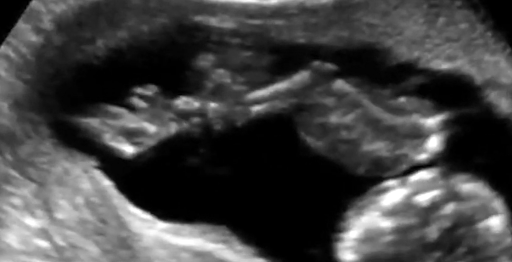
The baby can hear the mother’s heartbeat, digestive sounds, breathing and muffled voices. Babies hear vowels relatively well in the womb, which tend to be lower and louder than consonants, and they pass through the wall of the abdomen and the amniotic fluid better (Abrams and Gerhardt, 2000). As a result, at 35 weeks after conception, babies can already distinguish between different vowel sounds, but do not show the same sensitivity to different consonants (Shahidullah and Hepper, 1994).
In the womb, babies can also hear a language’s prosody. This is an important part of language that contains the general pitch, melody and rhythm of speech. In one study, newborns showed a preference to listen to language with the same prosody as they heard while they were still in the womb, even though no individual words were identifiable. The babies were learning about the prosody of their language even if they didn’t know what any of the words meant yet (Mehler et al., 1988). By week 37 of pregnancy, babies show a preference to listen to their mother’s voice over any other female voice, and to listen to a speaker of their native language over any other language (Kisilevsky et al., 2009).
Following birth, babies can tell apart most if not all of the sounds of the world’s languages – which includes some 600 consonants and 200 vowels (Ladefoged, 2001). Despite being born equally able to learn any one of 7,000 different languages, infants soon home in on the language(s) they are exposed to at the expense of those that they are not. Somewhere between 6 and 12 months of age, infants lose the ability to distinguish a wider range of sounds than is present in their native language (Werker et al., 1981). For instance, Japanese-learning infants soon have trouble distinguishing between the English ‘l’ and ‘r’ – not an important distinction in Japanese but it is in English. Likewise, English-learning infants soon have difficulty with Arabic sound ح, which is similar to the English ‘h’, but with a small puff of air released along with it – an important sound in Arabic but not in English.
This normal part of development is called perceptual narrowing and is driven by a genetic process in the brain that prunes away unwanted connections (Sakai, 2020). It allows infants to retain the experiences in their environment that are important and makes processing the languages they are exposed to more efficient.
In the following video, music therapist Jojo Lander talks about how sensitive babies are to their mothers’ and fathers’ voices while they are still inside the womb.
Watch the video by accessing the link below.
Video 2 Talking to the bump [Tip: hold Ctrl and click a link to open it in a new tab. (Hide tip)] (it is the third video on this page)
Because infants are already learning about language in the womb they are not born ‘blank slates’, empty of knowledge. They already know something of the way their language works and are born with expectations and preferences based on their experience.