

2 Face-to-face interaction
When newborns are just hours old, they typically prefer to look at faces that are looking back at them and focus in on the eyes, faces and mouths of other people (Konner, 2010). These face-to-face interactions can develop into proto-conversations – a back-and-forth exchange of smiles, mirroring of behaviour, touches and vocalisations, where both participants have a special motivation to share emotions with each other (Trevarthan, 1979).
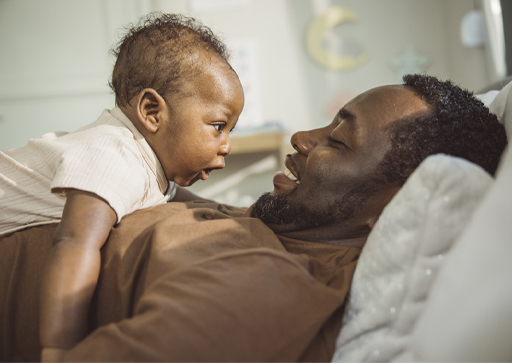
In these social situations infants begin to learn about turn-taking in conversation – the implicit expectations we all have about who speaks when and about what. In an analysis of ten languages of varied type, geographical location and cultural setting, researchers found that the way speakers coordinate their speech with each other, dovetailing their contributions in conversation, showed remarkable universality (Stivers et al., 2009). Across such different languages as Ākhoe Hai‖om, Danish, Dutch, English, Italian, Japanese, Korean, Lao, Tzeltal and Yélî-Dnye, speakers organised their conversations such that there was less than half a second between one person finishing talking and the next person starting.
Activity 1 Have you ever wondered what babies can see in their first few months?
Before you watch the video, write down why you think face-to-face interactions might be important for early language development.
Then watch Video 3.
Video 3 How far can newborns see? [Tip: hold Ctrl and click a link to open it in a new tab. (Hide tip)]
Discussion
Close face-to-face interactions allow babies to see mouth movements and relate them to the sounds that speakers are making. We know young infants pay attention to this kind of visual information because, impressively, 4-month olds can tell the difference between someone speaking in their own language versus a foreign one even when there is no sound (Weikum et al., 2007)! Face-to-face interactions also help to cement social relationships. Back-and-forth, face-to-face, turn-taking episodes between carers and infants express a sense of shared experience.