

5 Pointing and gesturing
Pointing and gesturing are important social skills that are present in all known human societies with some variation in form – in some cultures the norm is lip-pointing or chin-pointing rather than index-finger-pointing (Wilkins, 2003).
Pointing shows great variety and complexity in everyday social situations. Below are some examples of young infants pointing in everyday situations from a study by Carpenter et al. (1998) where parents made diary observations.
At age 11.5 months, after J’s mother has poured water into J’s glass at the dinner table, a few minutes later J points to the glass to request that she pour him some more. Interpretation: Attend to my glass; fill it up.
At age 13.5 months, while the mother is looking for a missing refrigerator magnet, L points to a basket of fruit where it is (hidden under the fruit). Interpretation: Attend to the basket of fruit; it’s there.
At age 14 months, two different children, J and L, have accidents when a parent is not looking; when the parent comes to investigate, the infant points to the offending object (i.e. the thing he bumped his head on, or the thing that fell down). Interpretation: Attend to that object; it hurt me/fell down.
Summarising the evidence from a range of research Tomasello (2008) concludes that infants have three social motives for pointing communicatively:
Sharing – they want to share emotions and attitudes with others.
Informing – they want to help others by informing them of useful or interesting things.
Requesting – they want others to help them to attain their goals.
Susan Goldin-Meadow has shown we can predict specific milestones in vocabulary and sentence complexity at age 3 and a half by watching how children move their hands two years earlier (Goldin-Meadow, 2009). And 14-month-old children who point at more objects than their peers typically develop larger vocabularies when tested again at 42 months old (Rowe, Ozcaliskan and Goldin-Meadow, 2008).
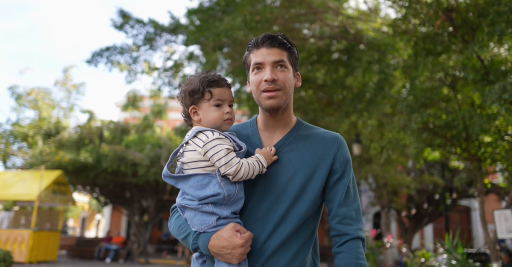
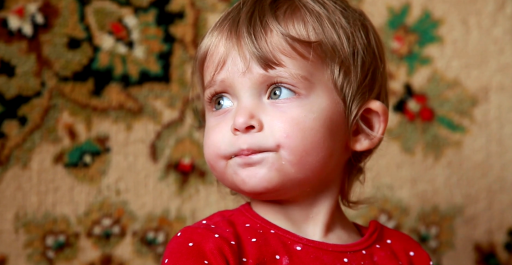
Pointing is a kind of attention-getting device, much in the same way language ‘points’ things out in the world and steers our attention towards something. Both pointing and language rely on similar social skills and are related in development, demonstrated in the following videos.
When people talk, they naturally gesture, and even young children move their hands when they speak. With iconic gestures the communicator wants the recipient to imagine something ‘like this’ by pantomiming the action. Here are a couple of examples of iconic gestures from Tomasello (2008):
At age 14 months, A tilts his head to the side to indicate to the mother what she should do to tip a bucket off her head. Interpretation: Attend to my action; do that!
At age 17 months, A pantomimes crumpling a ball of paper to ask that it be done. Interpretation: Attend to my action; do that!
However, many gestures are simply conventional, for example, the gestures for ‘OK’, ‘goodbye’ and for various obscene messages are not related to what they refer to in any obvious iconic way. Interestingly, infants acquire these conventional gestures at around the same age as linguistic conventions, suggesting that these two capacities share some of the same underlying psychological ability, namely the ability to use and understand social conventions.
When gestures from the hands, arms head and body occur at the same time as speech there is often a close correspondence between the gesture and the meaning or sound of the spoken utterance, for example a swift hand movement occurring just before or simultaneously with a stressed syllable in speech. Sometimes these co-speech gestures can reveal children have more knowledge than they are able to talk about, for instance, gestures that reveal that they understand a maths problem, but they are unable to verbalise the answer (Broaderset al., 2007). From around age 4 onwards, children use gestures to beat out the rhythm of an utterance, to mark new information in conversation or to focus attention onto a particular topic (Rohrer et al., 2022). These gestures help ‘package information’ for the listener and generally keep communication on track.