

3 Where are the words?
We are used to seeing the gaps between written words on a page so it’s easy to imagine that is how we speak and how we hear language. In reality, speech is more like a flowing stream of sound. As adults, we hear individual words because we have learned what language means and our brains insert a mental space between the words. You might have had the experience of listening to someone speak in an unfamiliar language. In that case, speech appears much more like a constant flow of sound. For children all language is unfamiliar to begin with. Their brains must make sense of this stream of sound and convert it into meaningful chunks of language, which you will explore in Activity 1.
Activity 1 Segmenting speech
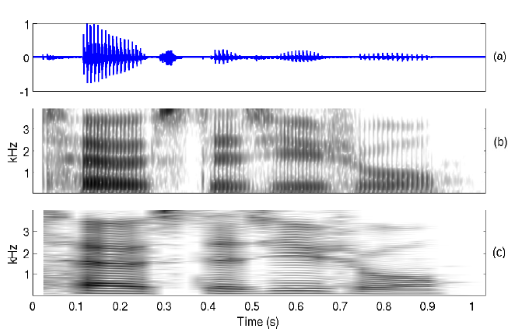
Have a look at the image below which is a sound recording of someone speaking. The top image shows the raw amount of energy in the sound wave and the bottom image shows the different frequencies. If you were an infant hearing this sound, how many words would you think there are? Add your answer to the text box below.
Discussion
The answer is three words. The person is saying ‘Toast as usual’, and here is how the words line up with the sounds.
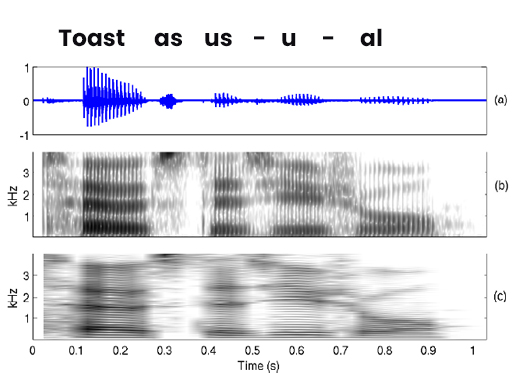
As you can see, sometimes the gaps in the soundwave align with the edge of words (e.g., ‘Toast_as’) but often they do not (‘us_u_al’). To make things more challenging the same word has a different soundwave depending on what other words surround it (e.g. saying ‘as’ at the start of an utterance will sound different than when it is embedded in the middle). Children learning sign language face a similar challenge to parse a stream of gestures into meaningful signs.
So, for infants, the meaning of an utterance is not bundled up into separate little packages but spread over the soundwave and changes in context. This makes segmenting speech into meaningful units a formidable challenge and one that takes months of careful listening, and trial and error. The soundwave also arrives rapidly: fluent speakers can utter three words a second so there is not long to work out what is going on before the next words arrive (Levison, 2016). And unlike trying to comprehend text, which sits on the page, the sound wave disappears into thin air milliseconds after it has arrived.
Somehow infants figure all this out. One source of evidence they use is sound frequencies. Notice the dark bands of the lower image you looked at in Activity 1. These indicate resonate frequencies and are often associated with vowels. Infants use the shape and position of these vowel frequencies to work out where the word boundaries might be (Mintz et al., 2018).
Imagine you have worked out where a word is. In the next activity you’ll try to work out what it means.