

1 Comprehension and production
Many researchers and parents have noticed that children, especially early on in their development, comprehend more language than they produce, referred to as the comprehension-production asymmetry. Across many different languages children understand more words, meanings, morphology and grammar, before they produce them. The fact that language comprehension and production dissociate like this suggests they are affected by different factors in development (see Figure 1).
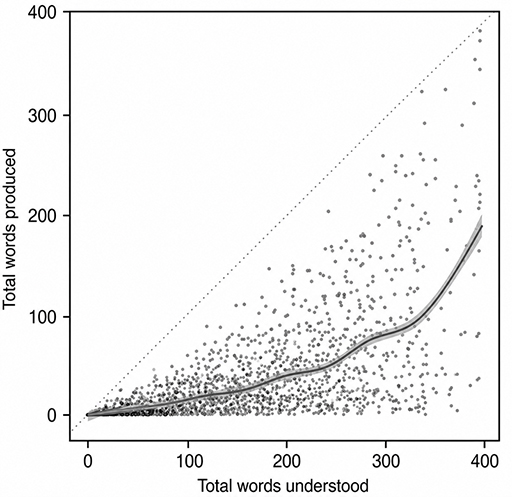
Acquiring some skills like riding a bike are judged on their performance. We don’t need to understand why someone else is riding a bike before we can ride one ourselves. Language is different. Comprehending why someone else is using a piece of language is crucial when learning to produce that piece of language ourselves. This is because there are certain norms that are shared between speakers about what words and phrases to use in certain contexts (think back to Session 2). Until children have some understanding of language, their ability to use it properly is limited, which is one reason we see a comprehension-production asymmetry. There are other reasons we see this gap. Producing speech or gestures requires significant cognitive effort, such as memory retrieval, planning, motor control (which you learned about in Session 3), and those abilities often develop later than the ability to recognise words.