

3 Models of development
As you follow children on their language learning journey, it is worth briefly pausing to consider some basic models of language development. You’ll take a look at a simple case first, and gradually build up to more complex but realistic examples.
Linear
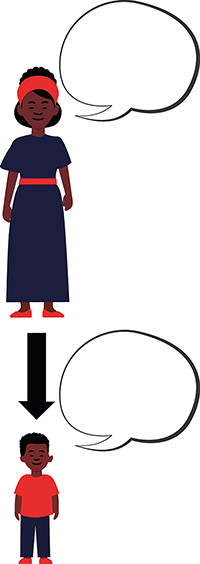
In this linear model of communication, information flows in one direction. The child is a passive recipient of language. It takes no account of what the recipient understands or doesn’t understand or how the speaker might monitor whether they are being understood. Messages are conveyed as separate packages, one at a time with neat beginnings and ends. Cause and effect are relatively easy to determine here, but from what you understand already about language development you might question how accurate this model of acquisition is. As the maxim goes, ‘Everything should be made as simple as possible, but no simpler’. Cause and effect are simple to understand here – but it is too simple, as it doesn’t explain how language acquisition works or describe the facts very well.
Interactional
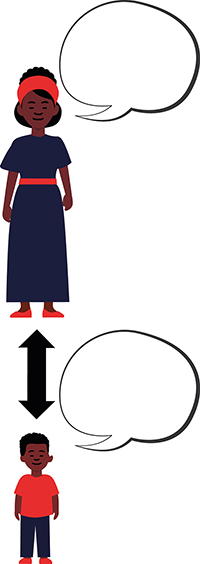
We could build a better model by representing information as an interaction between two individuals. Instead of a linear transfer of information, there is back-and-forth feedback between sender and recipient. The child here is no longer a passive recipient, but an active participant in conversation. It is a step towards acknowledging that participants bring different frames of reference and experience, and the wider communicative context can affect the meaning of the message.
Transactional
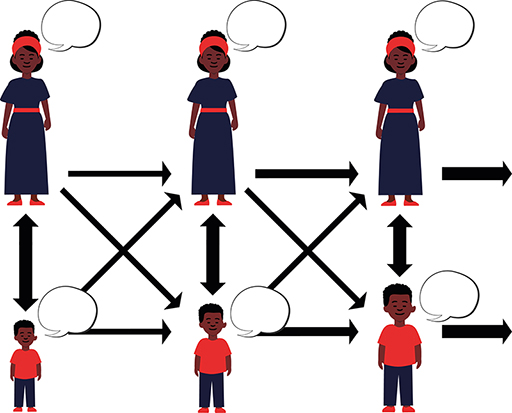
An even better model of communication is where someone could be a receiver and sender at the same time. In conversations messages are being sent and received not sequentially but simultaneously. Moreover, the nature of an interaction at a certain time point will be influenced by all those interactions leading up to it and influence all those that follow. Do caregivers speak in more complex sentences because children are speaking in a more complex way? Or do caregivers cause children to speak in more complex ways because they think the child is at a stage where they can understand more complex speech? Using these transactional models can help us answer ‘both’ to these types of questions and understand more complex webs of cause and effect.
As the child grows (literally gets bigger in the diagram above) the kind of language they produce at one time point influences the type of language they comprehend later. Child language is shaped by the adult input they receive, and children play a role in shaping the kind of input they get. These complex relationships are everywhere in language acquisition. For instance bilingual children tend to develop stronger social skills than monolinguals (Han, 2010), but children who are initially more socially skilled are more likely to become bilingual (Winsler, Kim and Richard, 2014).